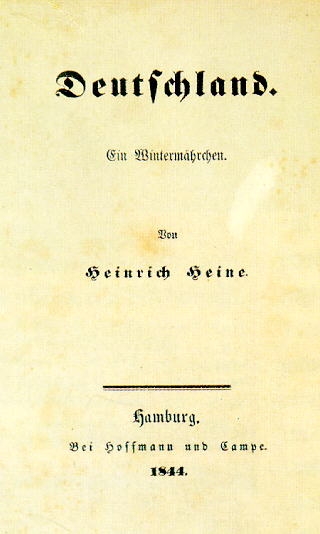
Including Thoughts on Heinrich Heine’s “Germany. A Winter’s Tale” and John Locke’s “Two Treatises of Government”
PART ONE
Just as in the year of 1844, when Heinrich Heine’s poem “Germany. A Winter’s Tale” was first published, today the grand idea of differentiating between the Fatherland and the state continues being relevant in any discussion in the realm of politics. As such this concept is key in developing one’s understanding when it comes to the philosophy of state. Thus, based on this revolutionary poem of Heinrich Heine’s, one begins one’s journey into comprehending the possible conflict between Fatherland and state.
Firstly, it should be stated that just as Heine understands the Fatherland as Germany in spirit and the state as the German government, this writer also defines the former as an esoteric concept and the latter as an attempt at material (but most often illegitimate) manifestation of the former. As such, in the beginning of this poem the main character who until this very moment had been in Paris expresses his exuberance upon the realization of his coming return to the Fatherland, as expressed in the line:
“This painful yearning drives me away,
Away from you, o sweetest fate!
I need to breathe German air again,
Or else I’ll suffocate.”
Only natural is his patriotic joy, as would be expected of any man who had not been in his Fatherland for an extended period of time. But, in contrast to his feelings of high German spirit are his feelings toward German government as are revealed in his dialogue with the “politically compromised” Rhine in the poem’s fifth part. There it is revealed that the Rhine, this fundamental symbol of the main character’s home – due to the despised aforementioned German government – has “so often tearfully prayed/That one day they (the French) may return.” With said German government exemplified by “the verses of Niklas Becker” in reference to the in part mocking repercussion that his poem “The Rhine Song”, lent itself to. Thus, we can conclude that the most important part of understanding the differentiation between Fatherland and state is the possibility of the two being in conflict and as a consequence a part of the former wanting to secede from the latter. One must then ask oneself – when does this conflict occur?
PART TWO
Freedom is defined by two things – possibility and choice. If one has the choice and possibility of doing or not doing something – then, in that regard he is free. If one does not have the possibility (for a choice only arises when there is a possibility) – then, in that regard he is limited and will either need to expand his capabilities or remains limited forever by some law of nature. If one were to have the possibility of doing something in a standard environment, but has his choice taken away from him by something outside of his immediate control – then, in that regard he is not free. Therefore, one must ask oneself – firstly, what freedoms should one possess (for example, the freedom to kill as one sees fit, without any regard for rules or laws, akin to the Hobbesian state of “the war of all against all”, is not at all beneficial to a healthy society) and, secondly, under what circumstances does a freedom that one does not usually possess – such as the right to resistance against the state – become a freedom that one does possess?
The answer to both questions with regards to the right to resistance against the state can be found in the 19th chapter of John Locke’s second treatise on civil government – “On the Dissolution of Government” – and more specifically in the following quote:
“That is in short—not to multiply cases—in whatsoever he has no authority, there he is no king, and may be resisted: for wheresoever the authority ceases, the king ceases too, and becomes like other men who have no authority.”
For does it not become too obvious from this thought that it is whenever the state (or how Locke is referring to it by naming its sovereign) is not strong enough to crush resistance that one gains both the possibility and the choice to fight against it. And, that in such a moment he has been granted an option that he does not usually possess – for otherwise there could be any number of forces plotting his destruction, but in the eve of a government’s dissolution there are none.
Therefore, we can conclude that the Fatherland and the state are to be distinguished as the nation in spirit and the – often illegitimate – attempt at its material manifestation, that the two can often be at odds with each other and such a statement holds true when a government drafts policies which make it weak. In such a case on the individual level one gains the possibility and the choice to openly defy the state in the name of the Fatherland (as Heine himself says: “This is my PATRIOTISM”), and on a collective level parts of a nation may rightfully choose to secede.