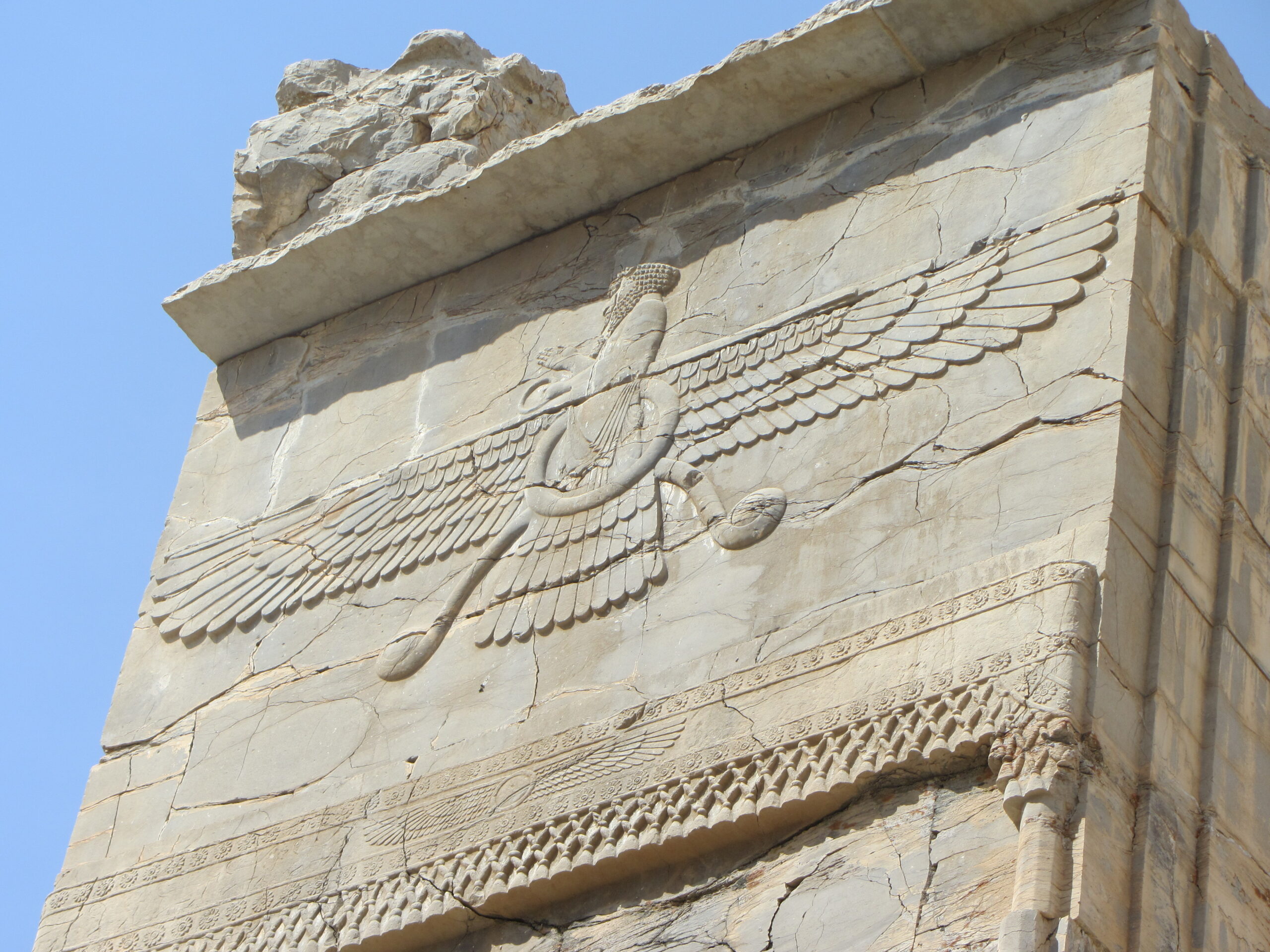
Part 8 of Nietzsche’s “Thus spoke Zarathustra” and the Identaria project
In general, references to ethnicity and to Europeanness in “Thus spoke Zarathustra” are rare. This is obviously done by Nietzsche to fashion the text in his quasi-Bible in a more authentic form. Very briefly, the Greeks, the Jews and the Germans are mentioned. The only time Germanness is mentioned (in the chapter “The welcome”) it is actually with ridicule as one of the two kings comments: “he does not know our dear Germans, this wise man from the East”. There are also four historical examples of peoples in the chapter “On the thousand and one goals” in which, however, only the Greeks are directly mentioned. It could be assumed that the other peoples are respectively Persians, Jews and Germans as suggested by Kaufmann (Kaufmann, 1976).
The only place where Nietzsche refers to Europe and Europeanness is in the multilayered chapter “Among daughters of the wilderness” and, more specifically in the ominous and surreal after-dinner psalm entitled “Wilderness grows: woe unto him that harbors wildernesses!” The playful psalm is written and performed with a harp by “the wanderer who called himself Zarathustra’s shadow”. The three daughters of the wilderness are described as “oriental maidens” and “my most charming girls”. They are also referred to as “girl-cats” and given the strange names of Dudu and Suleika. Zarathustra’s shadow praises the three daughters of the wilderness and the oriental air alike with the lines: “for near them the air was equally good, bright, and oriental; never was I farther away from cloudy, moist, melancholy old Europe.”
The strange events take place in an African wilderness. There is a certain eroticism in the psalm mixed with ridicule of the Christian God and some hidden terror. One of the oriental dance-girls loses her leg – probably “gnawed away” by a lion monster. Of great interest is the bizarre representation of the European, that is actually Zarathustra’s shadow in the psalm. Sitting under palm-trees in a small oasis the European is described as a powerless person, as “a doubter”. There is something fluid and powerless about this European who comes from Old-Europe (as is repeatedly stated). Phrases like “European dignity”, “European fervour” and “European ravenous hunger” in the text are charged with ridicule. Europe and the European are described as “more doubt-addicted than all elderly married women”.
Indeed, in some of his works Nietzsche has claimed to be a good European but this is not evident in “Thus spoke Zarathustra”. Judging from the chapter “Among daughters of the wilderness” – which is the only one referring to Europeanness in Zarathustra – it is difficult to accept Bowden’s assertion about Nietzsche’s civilizational Europeanness. Bowden states that Nietzsche “is not a German nationalist, but he is a European one” (Bowden, 2016). Given the bizarre representation of the European in the chapter “Among daughters of the wilderness” this is rather an overstatement, at least when it comes to “Thus spoke Zarathustra”. One could only tentatively suggest that Nietzsche was looking for a new “Eastern-oriented” European identity which is clearly distinct from “Old-Europe”. And the choice of the historical figure of a Persian prophet is clearly a sign of a broader Indo-European orientation. In “Thus spoke Zarathustra” Nietzsche seems to be interested in a broader, Indo-European “pagan” identity which breaks with the Judeo-Christian tradition and whose personified incarnation is the Persian prophet Zarathustra. As if Nietzsche refers to a primordial Europeanness, pointing at some deeper “Indo-European” roots. Could this be the Aryan concept which had its roots in philology studies and was very trendy in the 19-th century? To be precise, Nietzsche does not make use of the term “Aryan” in “Thus spoke Zarathustra”. However, he makes use of the term “Aryan” in one of his last works “Twilight of the idols” which was written only a few years after Zarathustra. As we shall see it is used to refer exactly to the primordial state of “Aryan humanity” (Nietzsche, Twilight of the Idols, 1976: 503-5).
Nietzsche’s peculiar and ambiguous attitude to Europe has also been expressed in “Beyond good and evil” in the context of his anti-Christian sentiments and his preference to the Old Testament. In a complicated section Nietzsche laments the ruins of “ancient Asia and its jutting peninsula, Europe”, writing:
“In the Jewish “Old Testament,” the book of divine justice, there are men, things, and speeches in so grand a style that Greek and Indian literature have nothing to compare with it. One stands in awe and reverence before these tremendous remnants of what man once was, and sad thoughts come to one about ancient Asia and its jutting peninsula, Europe, which wants so definitely to signify, as against Asia, the ‘progress of man’… To have glued this New Testament, a kind of rococo of taste in every respect, to the Old Testament to form one book—the ‘Bible’, the book—that is perhaps the greatest audacity and ‘sin against the spirit’ which literary Europe has on its conscience.” (Nietzsche, Beyond Good and Evil, 1976, Section 52).
The skepticism about Europe’s progress, especially vis-à-vis ancient Asia is very clear and chimes well with the “Aryan” zeitgeist of the 19-th century. Nietzsche himself does make use of the term “Aryan” in the last work he has published, “Twilight of the idols”. In the chapter “The ‘improvers’ of mankind” he analyzes the morality of breeding a particular race and kind. For Nietzsche, “the most magnificent example of this is furnished by Indian morality, sanctioned as religion in the form of ‘the law of Manu’” (Nietzsche, Twilight of the idols, 1976: 503-505):
“These regulations are instructive enough: here we encounter for once Aryan humanity, quite pure, quite primordial — we learn that the concept of ‘pure blood’ is the opposite of a harmless concept… Christianity, sprung from Jewish roots and comprehensible only as a growth on this soil, represents the counter-movement to any morality of breeding, of race, of privilege: it is the anti-Aryan religion par excellence. Christianity—the revaluation of all Aryan values, the victory of chandala values, the gospel preached to the poor and base, the general revolt of all the downtrodden, the wretched, the failures, the less favored, against ‘race’: the undying chandala hatred as the religion of love.”
The above texts are clear examples of how multilayered Nietzsche’s texts are and how many different interpretations they allow for. One could find some sort of Judophile attitudes in the cited passage from “Beyond good and evil”, however, the text from “Twilight of the idols” could be interpreted in a very different way. For example, in “Twilight of the idols” Nietzsche speaks of “the most beautiful specimens of the ‘blond beast’ and the noble Teutons” who were “hunted down” and “improved” by the church (Nietzsche, Twilight of the idols, 1976: 502). Even more so, the “Aryan” section about the morality of breeding could be interpreted in extremist terms.
Even though he does not make use of the term “Aryan” in Zarathustra Nietzsche makes indirect reference to the Persian origin of Zarathustra in the chapter “On the thousand and one goals”: “To speak the truth and to handle bow and arrow well”—that seemed both dear and difficult to the people who gave me my name—the name which is both dear and difficult to me.”
Echoing Herodotus Nietzsche singles out for praise the Persians’ mastery of archery and horsemanship, their war-like imperiousness, and their emphasis on the virtue of truthfulness. And, later on in the chapter “The welcome” one of the kings calls Zarathustra “this wise man from the East”.
One of the most political and at the same time mythical moments in the book is the prophesy of the “Zarathustra kingdom of a thousand years” (das Zarathustra-Reich von tausend Jahren) in the chapter “The honey sacrifice”:
“What must come one day and may not pass? Our great Hazar: that is, our great distant human kingdom, the Zarathustra kingdom of a thousand years.”
According to Ashoori this passage reflects Nietzsche’s deepest interest and admiration for the Persian concept of cyclical time which resembles to some degree his own concept of the circle of the eternal recurrence (Ashoori, 2003). Through this concept Nietzsche emphasizes the cyclical nature of cosmic time and the recurrence of all beings in every “circle”. In this fragment Nietzsche uses the Persian word hazār referring to the millennial cycles (hazāra) in ancient Persian religious beliefs, “each one presided by a prophet; every prophet having his own hazar, his millennial kingdom.”
Nietzsche’s admiration for the Persians to some extent explains why he has chosen exactly the Persian (Aryan) prophet Zarathustra as a prophet in his major work. In Avestan, the liturgical language of Zoroastrianism, “Airyanem Vaejah” is used to describe an ancient “Aryan expanse” which was the homeland of the Iranian people. Of course, of great significance is also the fundamental role of the historical Zarathustra for developing the concepts of good and evil which bear great significance for Nietzsche’s quest to go “beyond good and evil”. This is also closely connected with Nietzsche’s iconoclastic conception of the Greeks (the major historical opponents of the Persians) which is presented in his first book published in 1872: The Birth of tragedy. What it is best known for today is its contrast between the Apollonian (the serene sense of proportion which found its crowning expression in Greek sculpture) and the Dionysian (that flood which breaks through all restraints in the Dionysian festivals and which finds artistic expression in music). For Nietzsche the Dionysian signifies the flood of passion. It should be added that there is an ethnical aspect to this distinction too as Dionysus, unlike Apollon has Thracian origins. This is of great symbolical importance for present-day Bulgarians who are not only spiritual descendants of the Thracians but at least to some degree have a bloodline connection with this ancient Indo-European people as argued by some historians (Ценов, 2004).
In the chapter on Zarathustra in his autobiography “Ecce Homo” Nietzsche makes clear references to Dionysus: “my concept of the Dionysian here became the highest deed.” (Nietzsche, 1911). After citing Zarathustra’s verses in “Ecce Homo” Nietzsche specifies “this is the very idea of Dionysus”. Naturally, Zarathustra celebrates the Dionysian exuberance in dancing. Overall, in Nietzsche’s thinking Zarathustra is to great extent identical with the Thracian God Dionysus. In a certain sense Nietzsche further develops the Indo-European “pagan” tradition personified by Zarathustra and Dionysus opposing it to the Judeo-Christian tradition. This is the reason why Nietzsche is highly regarded in present-day “pagan” nationalist groups.
The historical figure of Zarathustra has not only religious and ethical but also ethnical implications as it is connected with the complex history of ancient Indo-Europeans in Inner Asia and their migrations. Some scholars argue that Zarathustra was a teacher in the context of a united Indo-European community and that he epitomizes the whole Indo-European spirit (Jorjani, 2016). Zoroastrianism has been the dominant religion of Indo-Europeans in Inner Asia until the adoption of Islam and Christianity. Zoroastrianism shaped one of the ancient world’s largest empires — the mighty Persian Empire. It was the state religion of three major Persian dynasties, until the Muslim conquest of the Sassanian Persian empire in the 7-th century A.D. Zoroastrianism was also a dominant religion in the Kushan empire which was established between the 1-st and 3-rd century A.D. in Inner Asia by the Tokharians who are considered to be among the “first Indo-Europeans of Inner Asia” (Narain, 1990). Under king Kanishka in the first half of the 2-nd century A.D. the Kushan empire enjoyed the most glorious period of its political power, cultural and religious syncretism. A large number of deities, appertaining mainly to the Zoroastrian pantheon — in addition to the Buddha — figure as the reverse side of Kanishka’s gold and copper coins (Narain, 1990: 166).
The hypothesis for Tokharian ancestry of Bulgarians was suggested by Tabakov (Табаков, 1995). Based on a linguistic and historical analysis he asserts that the mysterious Avitokhol, the first Bulgarian king of the Dulo dynasty specified in the Bulgarian Kings’ List is actually a composite name of two parts. The first part is the ancient Iranian title “Kavi” with the meaning “king” and the second part, “Tokhol” meaning “Tokharian” (spelled as “Tu-huo-lo” in some Chinese sources). Therefore, the composite name should be read as Kavi Tokhol meaning “King of the Tokharians”. Given the period of royal rule Tabakov considers the founder of the Dulo dynasty Kavi Tokhol to be identical with the Kushan king Kanishka.
Many scholars have pointed out evidence that the Bulgarians’ pagan faith before the adoption of Christianity had clear Zoroastrian elements and at least some parts of the Bulgarian population followed Zarathustra’s teachings. Stoyanov noted that the closest parallel to the square-shaped, flat-topped Bulgarian pre-Christian temples are the fire temples of Zoroastrian Persia (Stoyanov, 1994). Various Arab-Persian medieval sources report that Bulgarians are of “the faith of the Magi” — as Zoroastrian priests have been named at the time — and that they practiced “fire-worshipping” (al-Masūdī; al-Qazwini). Moreover, Stoyanov makes a direct link between Zarathustra’s teaching, the Bulgarian pagan faith and the great European Christian heresies in the Middle Ages many of which derived from medieval Bulgaria (Stoyanov, 1994).
Based on analysis of a group of pre-Christian Bulgarian temples Chobanov argues that Bulgarian pagan temples in the Lower Danube region show clear analogies with Iranian Zoroastrian fire temples (Chobanov, 2021). In his view their closest parallels and probably indirect antecedents were the temples of fire in Sassanian Iran (3rd–mid-7th century). During the 5-th – 6-th century A.D. Sassanian Iranians executed an active policy of strengthening the position of the state religion Zoroastrianism in the Caucasus region, including building some of the oldest and most famous Zoroastrian temples. In this period Bulgarians have been living north of the Caucasus mountains and most likely have been influenced by the policy of the Sassanian Persian empire. At this political backdrop, Chobanov considers the formation of “a strong Zoroastrian elitist layer” in the Bulgarian aristocracy in the 6-th – 7-th century period (Chobanov, 2021: 264).
“Thus spoke Zarathustra” reveals a primordial Indo-European zeitgeist which is typical for European romantic nationalism of the 19-th century. Interesting parallels could be drawn between Nietzsche’s “Thus spoke Zarathustra” and the poem “The Forest Traveller” by the Bulgarian national revolutionary and author Georgi Rakovski, one of the founding fathers of the modern Bulgarian state. “The Forest Traveller” was published in 1857 in Novi Sad, then in the Austrian empire. It describes the stories of Bulgarian rebels who have gone into the Balkan Mountains to fight against the Turkish yoke. To start with the name itself “the forest traveller” bears resemblance to “the wanderer” Zarathustra who has gone into the mountains looking for spiritual freedom. “The wanderer” is the title of the first chapter in Part Three of “Thus spoke Zarathustra” where he says: “I am a wanderer and mountain-climber, said he to his heart, I love not the plains, and it seems I cannot long sit still.”
The sun plays an important part in “Thus spoke Zarathustra” and “The Forest Traveller” alike. “Thus spoke Zarathustra” begins and ends with Zarathustra’s worship of the sun and his love to the sun is displayed in several chapters, most notably in the chapter “Before sunrise” and “On immaculate perception”. In the Prologue Zarathustra steps before the sun and speaks to it. “The Forest Traveller” also starts with a line about “the bright sun that has turned to darkness” in the Foreword to the Bulgarian people (Раковски 2021). In another text by Rakovski – actually a draft law of the Bulgarian revolutionary forces – “the bright sun” (along with the Gospel) plays also the part of witness when a new member of the revolutionary units is sworn in. Similar to Nietzsche, Rakovski is also engaged in esoteric writing and his works contain unexplained and even mystical elements. For example, in “The Forest Traveller” he refers to “the god Tor who had been praised by all peoples of combat” (Раковски 2021: 15):
“Торка бога са славили
Вси народи ратари.”
By the ancient name “Tor” Rakovski probably refers either to the Viking god Thor – who probably has Persian (Aryan) origins – or to the Chuvash god Tura (or Tore) who is still worshipped among the present-day Chuvash people, the descendants of the Savirs of Old Greater Bulgaria. The peoples of combat, of course, remind of Zarathustra’s Kriegsvölker in the chapter “On war and warriors”. Rakovski was also the first to argue as early as 1860 that Bulgarians are of Aryan ancestry (Раковски, 1984: 380).
In Nietzsche’s interpretation Zarathustra’s teaching is comprised of three main elements:
– beyond Good and Evil (the moral aspect of his doctrine);
– paganism, or at least pagan attitudes to life; and
– the concept of the eternal recurrence
Zarathustra’s paganism and the worship of the sun god are displayed at the very beginning in the Prologue when the prophet praises the morning sun. Also in the very last chapter, “The sign” Zarathustra comes out of his cave “glowing and strong as a morning sun that comes out of dark mountains” and addresses the sun with the words of a true sun-worshipper: “You great star, you deep eye of happiness”.
There is a whole pagan chapter in Zarathustra – “Before sunrise” dedicated to the sky-god:
“O heaven above me, pure and deep! You abyss of light! Seeing you, I tremble with godlike desires. To throw myself into your height, that is my depth. To hide in your purity, that is my innocence.”
In this chapter the sky-god is presented as an alternative to the Christian god which reminds of the fact that in traditional Zoroastrianism the sun was deified as Mithra. In another chapter – “On immaculate perception” Zarathustra praises the sun and the sun’s love for the earth in a very vivid and surrealistic, almost erotic way:
“Look there: how she (the sun) approaches impatiently over the sea. Do you not feel the thirst and the hot breath of her love? She would suck at the sea and drink its depth into her heights; and the sea’s desire rises toward her with a thousand breasts.”
The crux of Nietzsche’s paganism is his critique against the claim for one and only God. He is not exactly godless (as stated in the chapter “On virtue that makes small”) but rather anti-monotheistic. His paganism is actually a defence of the possibility for many gods as specified in the chapter “On Apostates”:
“the most godless word was issued from one of the gods themselves—the word: “There is one god. Thou shalt have no other god before me!”
Judging from this we could conclude that Nietzsche’s form of Zoroastrianism is actually faith without one God but with many. How Indo-European, all too Indo-European…
Bibliography
Ashoori, Daryoush. ‘Nietzsche and Persia’, Encyclopaedia Iranica, July 2003. Available at: https://www.iranicaonline.org/articles/nietzsche-and-persia
Bowden, Jonathan. ‘The Uses and Abuses of Nietzsche’, Counter-Currents webzine, 15 April 2016. Available at: https://counter-currents.com/2016/04/the-uses-and-abuses-of-nietzsche/
Chobanov, Todor. ‘Medieval temples of a pre-Christian religion and their priests’ In: From the Huns to the Turks – Mounted Warriors in Europe and Central Asia. Internationale Konferenz am Romisch-Germanischen Zentralmuseum – Leibniz (Mainz, 25. –26. April 2018), Tagungen des Landesmuseums fur Vorgeschichte Halle, Band 23, 2021.
Jorjani, Jason Reza. Zarathustra’s Indo-European legacy, a conversation with Jeffrey Mishlove, Nov 7, 2016 in the podcast New Thinking Allowed – available at: https://www.youtube.com/watch?v=WjYpghe1bCc
Kaufmann, Walter. ‘Introduction and editor notes’, The portable Nietzsche (Penguin Books, 1976).
Narain, Awadh. ‘Indo-Europeans in Inner Asia’ – In: Denis Sinor (ed.) The Cambridge History of Early Inner Asia (Cambridge: Cambridge University Press, 1990), pp.151-176.
Nietzsche, Friedrich. Thus spoke Zarathustra. A book for all and none, trans. Walter Kaufmann (Penguin Books, 1976).
Nietzsche, Friedrich. Beyond Good and Evil, trans. Walter Kaufmann (Penguin Books, 1976).
Nietzsche, Friedrich. Twilight of the Idols, trans. Walter Kaufmann (Penguin Books, 1976).
Nietzsche, Friedrich. Ecce Homo, trans. Anthony M. Ludovici (Edinburgh and London: T. N. Foulis, 1911).
Stoyanov, Yuri. The hidden tradition in Europe. The Secret history of medieval Christian heresy (London: Penguin Books, 1994).
Раковски, Георги. Няколко речи о Асеню первому, великому царю болгарскому и сину му Асеню второму, София: 1984 (първо издание – 1860).
Раковски, Георги. Привременен закон за Народните горски чети за 1867 лято. https://chitanka.info/text/7421-privremenen-zakon-za-narodnite-gorski-ch
Раковски, Георги. Горски пътник (София: Българска история, 2021).
Табаков, Димитър. К-ави (Кава-Кана) Туохол (Авитохол), сп.Ави-тохол №1, 1995.
Ценов, Ганчо. Кроватова България и покръстването на българите (София: Издателство „Хелиопол“, 2004).
Nikolay Pavlov