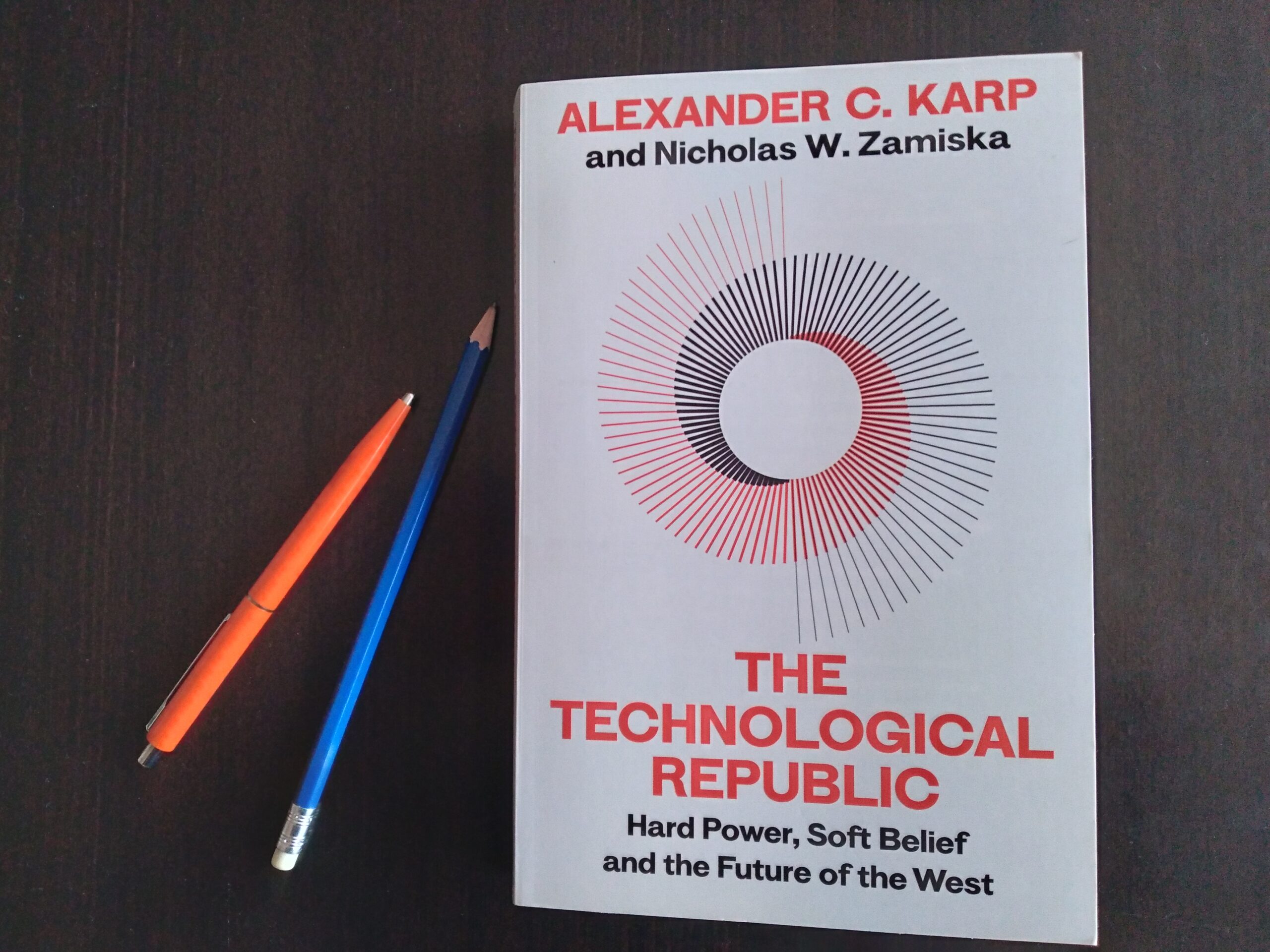
 The Technological Republic by Alexander C. Karp and Nicholas W. Zamiska is a well-informed and insightful work which would feel somewhat soft for the fans of Elon Musk but is certainly hard for authors from a Silicon Valley tech company. The book reveals at least part of the corporate ideology of the powerful software company Palantir, which is valuable especially for those interested in startup technology culture.
The book is very well-written and parts of it, especially Part I: The Software Century sounds credible in academic terms. The authors’ main assertion is that “a more intimate collaboration between the state and the technology sector, and a closer alignment of vision between the two, will be required if the United States and its allies are to maintain an advantage that will constrain our adversaries over the long term”. The thesis is clearly defined and well-argumented throughout the book. The main policy recommendation is that the U.S. and its allies abroad should without delay commit to launching a new Manhattan project, in order to retain exclusive control over the most sophisticated forms of Artificial Intelligence (AI) for the battlefield – the targeting systems and swarms of drones and eventually robots. Of course, it is up to the book’s main target group, the technological class in the Silicon Valley to accept or dismiss the overarching message in The Technological Republic. On my part, as an outsider from Europe such an enhanced collaboration seems entirely logical and it is strange that it is not actually happening. The book offers an explanation for this state of affairs by the powerful mechanism of the “disapproval of the crowd” hinting at left-wing and progressive ideological dominion over Silicon Valley. The attack against the left establishment, however, is moderate and cultured. No direct assaults on political correctness either.
The authors have put a lot of effort and energy in clarifying the complex issue of national identity which is widely contested in the academia and the policy domain alike. The defence of the concept of the nation and the nation-state is welcome but lacks detail. The authors’ critique of “the hollowing out of the American mind” is credible and very relevant for Europe as well, especially for Germany. On the other hand, the authors’ understanding of patriotism is not clearly explained and somewhat ambiguous. For example, how is this “technological” American patriotism related to Trumpism or to “White nationalism”? Some major contributions in the field (e.g., the views of the French philosopher Ernest Renan) are briefly presented. It is also positive that the diverging views on the slippery concept of “the West” (and “Western civilization”) are specified. On the other hand, the thorny issues of race and ethnicity are very cautiously touched upon. The complex issue of multiple identities and allegiance to other nation-states (apart from the U.S.) is not addressed.
The book’s major shortcoming is that the proposed technological republic is described in very general terms. We are told that the United States since its founding has always been a technological republic, one whose place in the world has been made possible and advanced by its capacity for innovation. It could be argued that a major political innovation – known as the American Revolution – combined with the deliberately constructed tradition from the Roman Republic have played greater role in the historical development of the U.S. compared with technological innovation. Could we then apply the term “political republic” to the U.S. and what sense does it make in practical terms. What about the role of the Puritans in the development of New England and some of the other colonies? All this cannot be subsumed under technology but rather under politics and religion.
The proposed rebuilding of the technological republic (Part IV) is also described mostly in general terms. What does “a reassertion of national culture and values” actually mean? How will the “construction” and “resurrection” of national identity in the proposed new American national project be carried out? Will politics in the U.S. be abolished? Will politicians be replaced with AI? Do the authors foresee some sort of merging of the technology, military and policy domains? Is the technology republic a sort of technology-based utopia? Will it be implemented across the U.S. as a whole, across red states only or in the technology companies on the small patch of land in Santa Clara County? What is the implementation plan and the timeline? Is this some novel politico-engineering project and is Palantir jumping into American politics? Is the “engineering mindset” able to understand the intricacies of politics? How will resistance to the project be countered? Overall, the concept of the technological republic needs to be further developed and substantiated to really make a difference. Or, alternatively the authors might choose to lower the level of ambition and confine the technological republic within the communal experiment of a single technology company. Something like “Palantir First” comes up as an apt slogan in such a scenario.
The relevance of The Technological Republic for the establishment of Identaria
Despite its shortcoming The Technological Republic is intellectually stimulating and very relevant for the establishment of Identaria in three respects. First, although being non-technological in essence Identaria is conceived as a geopolitical startup and as a “disruptive project” on the international arena. The book has lot to offer in terms of grounding disruptive organizations and “insurgent startups” including reflections on the “improvisational startup”, the honeybee swarm and the organizational culture of Palantir. Secondly, The Technological Republic highlights the significance of defence-related research, technology and innovation which is very relevant for the Research Programme of the European patriotic forces elaborated under the Identaria project. Indeed, given the present balance of power in the EU Parliament and the European Commission it is not realistic to expect a more patriotic re-direction of the European Research and Innovation Programme “Horizon Europe” or the European Defence Fund. The book is just another argument that the development of an independent Research Programme affiliated with the two Patriotic parliamentary groups in the EU Parliament (Patriots for Europe and Europe of Sovereign Nations) should be pursued and accomplished before the next EU parliamentary elections in 2029. Third, The Technological Republic clearly showcases the strategic importance of Artificial Intelligence for gaining superiority in the battlefield. Therefore, a specific research topic addressing the rise of AI and its potential for the European patriotic forces should be included in the Preparatory action for the Research Programme.
Nikolay Pavlov