On September, 29-th 2024 for the first time the Freedom party (FPÖ) won the most votes in an Austrian national election. The Freedom party won 29 % of votes, beating the ruling Austrian People’s party (ÖVP) and the once powerful Social Democratic party. The historical success of the Freedom party lead by Herbert Kickl is of great importance for Austria, however, taking the power seems not very likely. All other four parties in the Austrian Parliament are preparing a blockade by forming a coalition against the Freedom party and, especially against Kickl personally. The efforts to block a government of the Freedom party lead by Herbert Kickl will be considerable and even in case such a government is formed it will most likely not be stable enough to survive for a longer period. Nevertheless, the historical success of the Freedom party could have significant international implications for Europe and the patriotic forces in Europe as a whole. Most naturally, it will give impetus and further motivation to other patriotic and nationalist parties all over Europe in their political struggles. Moreover, the success of the FPÖ could provide the opportunity for a leading role of the party in prospective European identity politics.
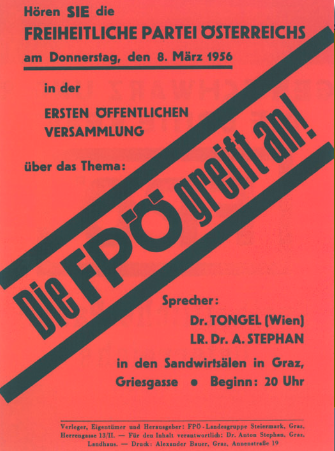
Austria’s Freedom party (Freiheitliche Partei Österreichs, FPÖ) is one of the oldest and strongest nationalist parties in Europe. Its history could be traced back to the German national-liberal movement of 1848, and especially the university students unions (called „Burschenschaften“) in the Habsburg empire. The Freedom party was formally established in Vienna, at „The white rooster“ hotel in 1956 shortly after the end of the 10 year-long post-war period when Austria was occupied by the allies – the USA, the Soviet Union, the UK, and France. In his inaugural speech Anton Reinthaller, the first FPÖ party leader declared: „In its essence, the national idea means nothing other than a committment to belonging to the German people. But the peoples of Europe can only exist if they join forces.“ The second part of Reinthaller’s statement is very relevant for the development and implementation of European identity politics today.
European identity politics seeks to protect the interests of people of European descent who are willing to preserve their national and European identity. This large group of European and national identity keepers have been subject to identity-based discrimination and oppression over the last decades in Europe and beyond. A great number of group members have suffered because of differences or conflicts between their particular European identity and the dominant multiculturalism-based and essentially ethno-masochistic identity of the political class, the media and academic establishments. European identity politics must ensure that European and national identity keepers as a group deserve respectful acknowledgment of their distinctive belief systems, values, and ways of life at the European level. European identity politics is closely connected with the fundamental right of all European peoples to self-determination and sovereign homelands.
After the great election victory of September, 29-th 2024 the FPÖ has the credibility and democratic legitimacy to play a leading role in developing and implementing prospective European identity politics. Unlike some other nationalist parties in Europe Austria’s Freedom party has sound ideological foundations. Its ideology is based upon the defensive concept of “fortress Austria” (Festung Österreich) which clearly corresponds with the broader concept of “fortress Europe”. The FPÖ Programme for the 2024 elections is titled “Fortress Austria: fortress of freedom”. It entails four main elements: individual freedom (individualism), sovereignty (including neutrality), homogeneity (including remigration) and solidarity. Very importantly, the Freedom party takes efforts to put these complex and abstract concepts into political practice. For example, the party has called for an EU “remigration commissioner” with a clear mandate to fight illegal migration and proposed a high-ranking party representative, Dr. Susanne Fürst for the post. It should be noted that the fight against illegal immigration is inseparable from the defence of national and European identity. Both policies could be pursued within a comprehensive European identity politics initiated by the Freedom Party of Austria in collaboration with the other parties in Patriots for Europe, the third largest political group in the European Parliament. This will be in line with the well-developed Austrian tradition of enhancing international cooperation and will directly contribute to international peace and security.