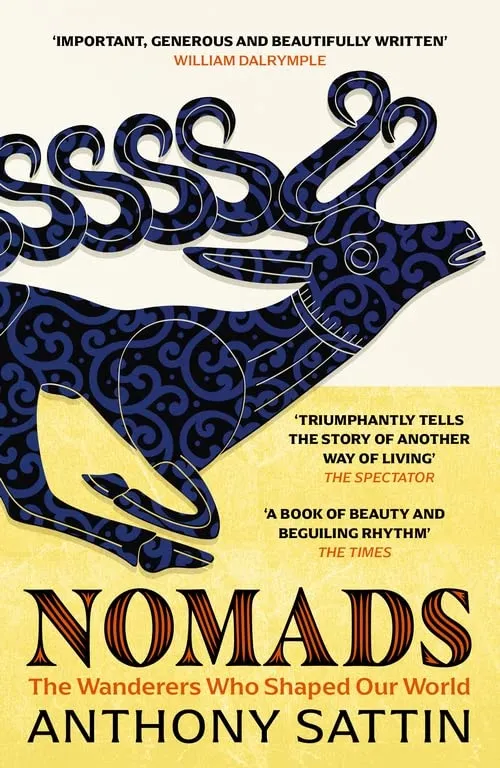
 The deployment of nomadism in politics and geopolitics is a fresh and practical idea which is very relevant for the Identaria project. Recently, nomadism has been examined from an idealist and leftist perspective by Anthony Sattin in “Nomads. The Wanderers who shaped our world” (Sattin, 2023). It is a professionally written and well-informed journalist work which seeks to present a history of nomadism. The author strives to re-evaluate nomadism by highlighting the contributions of nomads in advancing civilization – an attempt which has been acclaimed in a review as “a much-needed act of historical revisionism”. In a very generous style Sattin claims that nomad peoples “brought a glorious cultural flourishing to Eurasia, enabling the Renaissance and changing history”. One of the positive aspects is that the Indo-European nomadic tradition is adequately presented in the book. From a scholarly perspective, of most interest is the hypothesis of a Scythian Empire (Sattin, 2023: 81) but it is not sufficiently elaborated.
The book’s major shortcoming is the idealist-leftist ideological framework and the overarching objective to justify modern leftist ideological concepts such as multiculturalism and diversity with selected examples from the history of nomadic peoples. The multiculturalism and even universalism of the despotic Persian empire under Cyrus the Great seems an overstatement (Sattin, 2023: 86). Equating historical nomads with present-day migrants is not convincing and not sufficiently substantiated. For example, the nomadic urge in history has been an integral part of a complex process of nation- and state-building, especially in Eurasia. One possible explanation of this process has been done by Gumilev in his “passionarity” theory of ethnogenesis (Гумилев, 2003). If one equates historical nomads with present-day migrants, then one should also examine the empirically proven link between nomadic invasions and the replacement of local populations, including mass extinctions.
From a rigorously scholarly perspective, the book’s basic distinction – between nomads and settled peoples – is far from absolute. There are many examples of peoples – Vikings, Anglo-Saxons, Bulgarians and Goths, among others – who, in different periods have acted both as nomads and as settled people. Very often historically only parts of the population (most notably, the armed forces) have been nomadic. There are many shades of nomadism, some of which quite settled – even on a personal level within one person’s life-time. To some extent this shortcoming is understandable as the book’s subject matter is very broad covering a very large number of very different nomadic peoples. What is not understandable, however, is that acts of genocide committed by some nomadic peoples have been played down (as in the case of the Mongol empire) or grossly overlooked (as in the case of the Ottoman Turks). Characterizing the genocidal Mongol rule as “rule of law” (Sattin, 2023: 157) is not simply a falsification of the past but a justification of the genocide of tens of millions of people. Similarly, the acts of genocide committed by the Ottoman Turks against millions of Christians on the Balkans in the period between the 15-th and the 20-th century should have been clearly specified and denounced. As it stands now, the defence of uncontrolled immigration in “Nomads” is built upon deliberately playing down or justifying past atrocities committed by non-European “migrants”.
Nomadism is an important topic and it can be of great practical significance for the Identaria project and European nationalism as a whole. First, there is a strong Indo-European nomadic tradition which is closely connected with the Indo-European warrior spirit. Genetic research shows that Indo-Europeans are one of the three distinct population movements into Europe during pre-historic times (MacDonald, 2019: 3). The Indo-Europeans originate in the Yamnaya archaeological culture of the Black Sea steppe region in present-day Ukraine and Southern Russia. The massive Indo-European migration from the Steppe is most probably closely connected with the Scythians and their nomadic culture. Apart from the genetic legacy the Indo-European “steppe ancestry” includes metallurgy, horse riding and probably Indo-European languages (Haak et. al., quoted in MacDonald, 2019: 6). In this context, European nomadism is closely connected with military professionalism until the end of the Early Middle Ages in the 10-th century AD and even later with phenomena such as the Christian military orders.
Historically, there are two types of European nomadism which follow the basic geopolitical distinction between land- and sea-power. Based on a historical and geographical analysis Mackinder argues that the vast continental area of Eurasia – which is covered mostly with steppes – is the pivot region of the world’s politics (Mackinder, 1942). Historically, the Heartland is associated with land-power and the constant “hammer blow” of horsemen riding from the Heartland into the European peninsula. The Rimland of the World-Island is associated with sea-power which is in constant rivalry with the land-power. Of course, this distinction is far from absolute. Both poles of geopolitical power could be found in European nomadism – with Vikings and Anglo-Saxons as representatives of “sea nomads” and Goths, Bulgarians, Hungarians and to some extent Franks as representatives of “land nomads”. Very importantly, the nomadism of these mobile warrior peoples and their fight against the sedentary Roman empire played a central role in their nation-building process. Many modern European nation-states actually originate from nomadic peoples and their complex interactions with the Roman empire. Therefore, historically nomadism is closely connected with the nation-state in Europe and more broadly with European nationalism.
Nomadism plays an essential part in the context of the Identaria project as a peace-building project examining the feasibility of a European nationalist homeland. As a political act and tactics nationalist nomadism is crucial for the development of Idenatria as a hub for the European nationalist “tribe”. As set out in the project’s concept Identaria could be formed by regular and constant nationalist mobility (migration) from the U.S. and European countries to the fitting host country. Nationalist expats coming from the U.S. and European countries will be “the steppe nomads” of Identaria. The development of a European nationalist homeland will provide a territorial safe haven, a “steppe homeland” for European identity keepers and nationalists who have for long been “ideological nomads” and outsiders in their home countries. In line with the virtues of nomadism Identaria can provide free space for European identity-based multiethnicity and diversity by harmonizing the diverse identities, interests and cultures of the European nationalist “tribe”. As Sattin puts it, the vital energy necessary for a new beginning came from people who lived on the move (Sattin, 2023: 150). This “vital nomadic energy” will certainly be very useful for the implementation of the Identaria project as a European nationalist and nomadic project.
Bibliography
Mackinder, Halford J. Democratic Ideals and Reality: A Study in the Politics of Reconstruction (London: Constable Publishers, 1942).
MacDonald, Kevin. Individualism and the Western Liberal Tradition: Evolutionary Origins, History, and Prospects for the Future (Amazon Kindle direct publishing edition, 2019).
Sattin, Anthony. Nomads. The Wanderers who shaped our world (London: John Murray, 2023).
Гумилев, Лев. Ритмы Евразии: Эпохи и цивилизации (Москва: Кристалл, 2003).