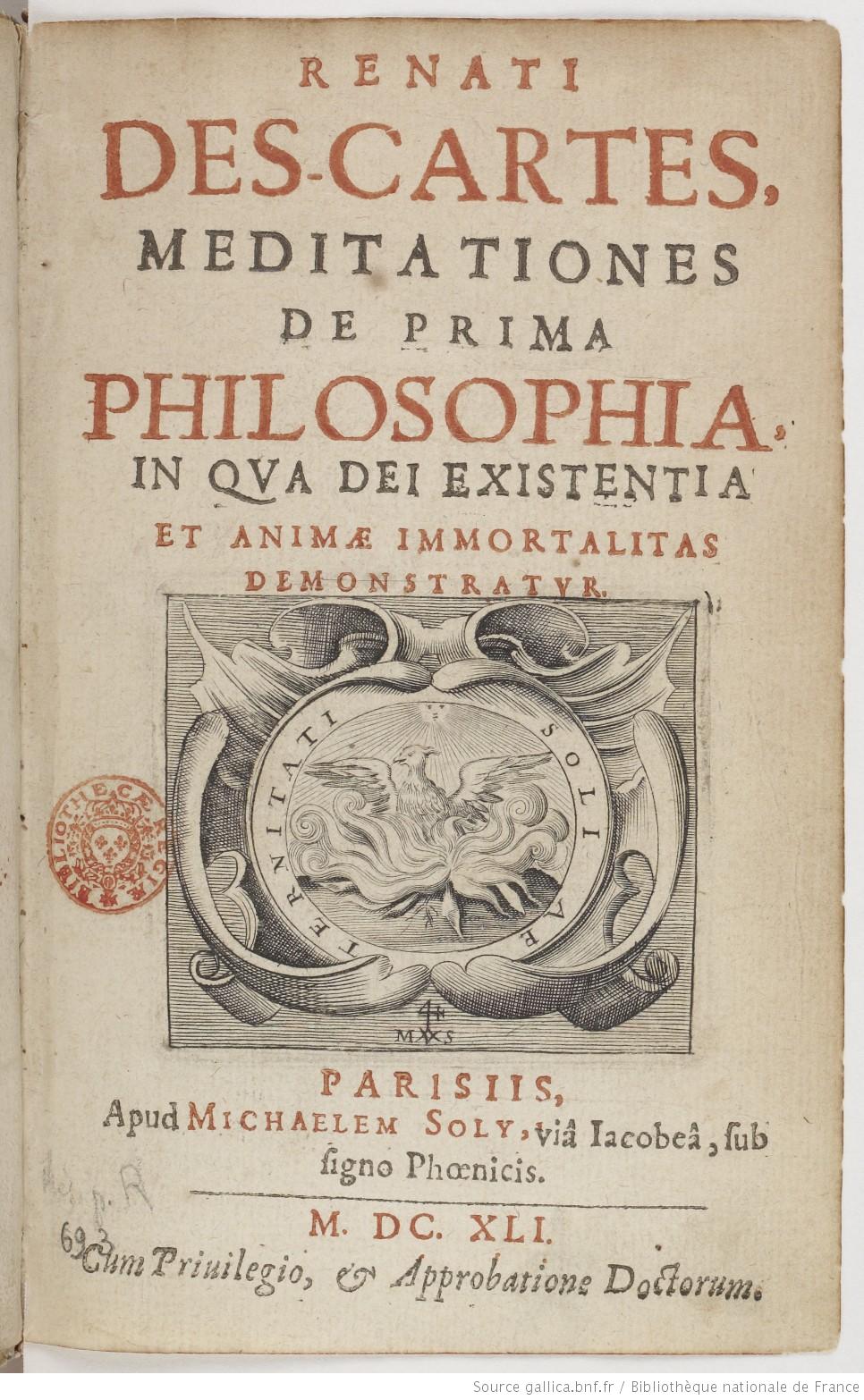
 How to identify oneself (based on René Descartes’ “Meditations”)
In his “Meditations on First Philosophy” of 1641, René Descartes outlines a similar thought process to the one he has become famous for in his “Discourse on the Method”, written four years prior in 1637. In the “Meditations” he expands upon his famous cogito ergo sum idea. It is precisely because we can doubt our own existence that we become sure of it, for the thing that thinks must exist in whatever form it may have been created, even if by “some evil mind, who is all powerful and cunning”, as Descartes describes it, in order to think in any capacity whatsoever. Precisely this “I” that is engaged in the act of thought is the thing, which can in no case be thought to not exist if one is to have the slightest bit of doubt about everything else. That is why Descartes describes the main characteristic of the human as being a “thinking thing”, as opposed to any other action that one would consider customary for the human such as living, speaking or breathing for example. This leads to his famous conclusion – that “I think, therefore I am”.
That idea, however, begs the question of what actually constitutes “I”. For if one cannot be sure about any of the things that one uses to identify oneself in the material world such as his physical form (as Descartes says – that he should imagine himself as if he has “no hands, no eyes, no flesh, no blood, no senses at all”), then (as we’ll see further on) he must identify himself through the lens of his ideas.
The entire point of the six meditations, as the subtitle describes, is that the reader should be made to feel that by the end “the existence of God and the immortality of the soul are demonstrated”. While he seeks to accomplish just this task, Descartes falls back on the centuries-old ontological argument made by Saint Anselm of Canterbury for the existence of a being, more perfect than which it is impossible to conceive of. However, in order to prove that it is possible that the idea of a perfect being can be thought up in the first place it must also mean beforehand that two other things exist – one, something which is capable of having ideas in the first place and, two, ideas themselves. The former has already been proven to exist by virtue of the fact that it can think, because then it must also follow that it really exists and the latter exists in an immaterial capacity as well as a result of the “thinking thing”. This is enough for Descartes to conclude that God also exists at the very least as the idea of a being, another, greater than which, cannot be thought of. It would not be possible to guess at this being’s characteristics, but one of its essential elements would be that it exists, because it is indeed so perfect. This writer does not make any comment on the existence of God, but would rather like to focus on one of the specific features of Descartes’ argument.
It is this “I”, which is a “thinking thing” and therefore exists and the ideas that “I” has that can be the only things, of which one would be certain if the concept of a perfect and thereby not deceitful God is not assumed a priori as the ontological argument does. Thus, we can ascertain that the only thing, through which we can identify this so ambiguous “I” is the only other certainly existing thing – its ideas. In fact, if one should choose to observe how people define themselves in life, he will notice a different, but similar principle – people tend to identify themselves by whatever it is they think they have the best ideas about. If that is philosophy, they call themselves philosophers. If that is their ideas about space objects, they call themselves astronomers. If that is of science, they call themselves scientists. If that is of the psyche, they call themselves psychologists. And if one identifies with many ideas (although that kind of person is quite rare and is most often reserved for people of a truly great intellect) he once again tends to be remembered for those that were his best. That it is not often the case that they are correct in their self-identification and that they should sometimes pick something else is beyond obvious, however. This is the process of self-identification through the lens of ideas. Therefore, if one cannot be certain of the existence of anything else other than himself – this “thinking thing”, and the products of its thought – those being ideas, then he must identify himself through the lens of his ideas. The greatest risk in this process, however, is to have a false identity created maybe not by “some evil mind, who is all powerful and cunning”, but by one’s own misguided mind.