Although being contested and somewhat dated the concept of a sovereign (or a king, to put it plainly) may still be relevant for the establishment of Identaria. The king is a traditionalist concept and royal dynasties have played a major part in the nation-building processes all over the world. Despite the republican tradition in the U.S. President Trump is seen by some of his nationalist admirers as a king, or even as an emperor.
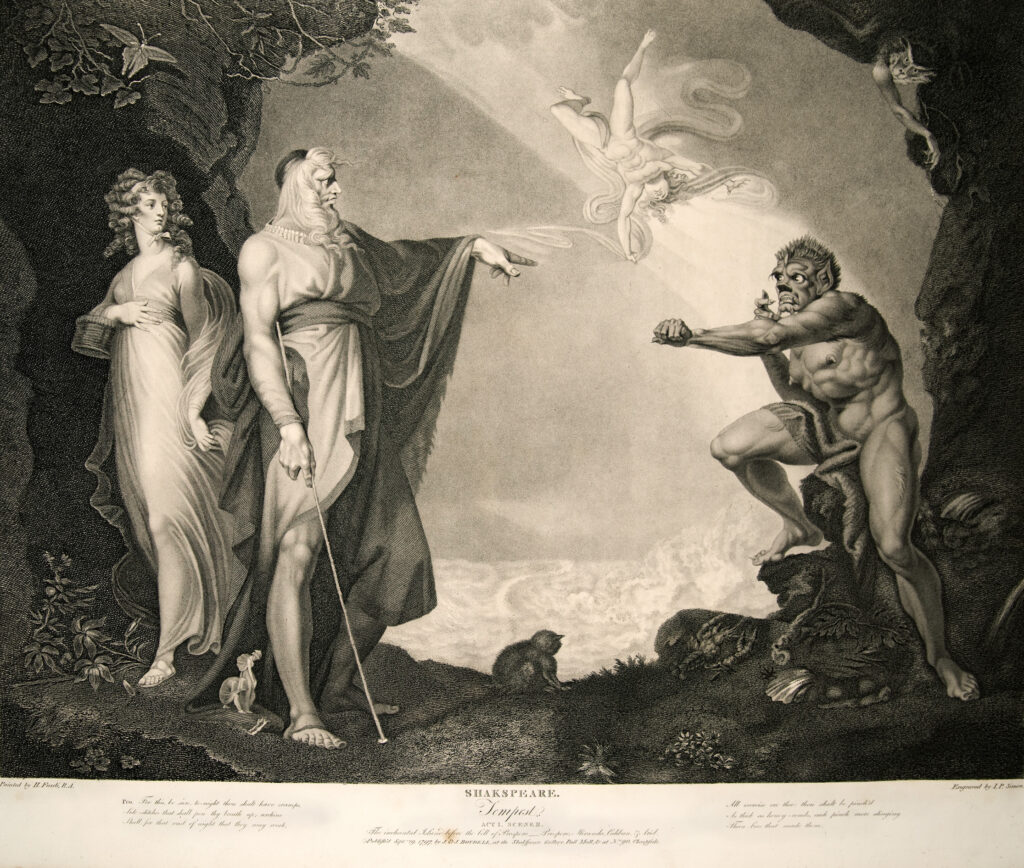
A magnificent example of the classic trope of the return of the king is one of Shakespeare’s last plays – “The Tempest”, which was probably written in 1610-1611. It tells the story of Prospero, a sorcerer king who had been the right Duke of Milan before being usurped by his treacherous brother Antonio. Escaping by boat with his infant daughter Miranda, Prospero leaves to a remote island where he develops magic powers. When a ship carrying his brother Antonio passes nearby, Prospero raises a tempest with the help of his airy spirit Ariel and the ship is destroyed. At Prospero’s bidding all passengers survive. The play’s plot provides some ideas and hints as to why raising a tempest in Uneurope is essential in identity terms.
First, the play takes place in the confined space of Prospero’s enchanted island. This “most desolate isle” is a place of visions, spirits, noises and music. It can be a paradise but also a “fearful country” as one of the characters names it. A closed and enchanted space is also needed to develop Identaria as separate territorial entity for breeding a European nationalism of a new and peaceful type.
Secondly, despite the unfavourable conditions on the isle the royal institution continues its existence there. Apart from his savage and deformed slave Caliban the sorcerer king has at his command a host of spirits and “strange shapes”. “Rapt in secret studies” the usurped king had developed strong magic powers the source of which are his books. When a conspiracy against Prospero is being prepared one of the conspirators, Caliban says: “remember, first to possess his books; for without them he’s but a sot, as I am, nor hath not one spirit to command.” Actually, the figure of Prospero combines the king, the sorcerer and what we would now call the scientist, given the close link between magic (“occult sciences”) and the emerging science of the Enlightenment era.
It should be noted, that an alternative utopian governance model is sketched out in “The Tempest” by the honest old counsellor Gonzalo:
“Had I plantation of this isle, my lord and were the king on it, what would I do?… In the commonwealth I would by contraries execute all things; for no kind of traffic would I admit; no name of magistrate; letters should not be known; riches, poverty… no occupation; all men idle, all; and women too, – but innocent and pure; no sovereignty… all things in common nature should produce without sweat or endeavour: treason, felony, sword, pike, knife, gun, or need of any engine, would I not have; but nature should bring fourth of its own kind, all foison, all abundance to feed my innocent people… I would with such perfection govern, sir, to excel the golden age.”
This “nature-based” governance model is not further developed in the play and stays as an example of a utopian commonwealth against the traditional model of a kingdom. Gonzalo’s critics are fast to point out some internal contradictions in the model – the dream of “no sovereignty” but at the same time Gonzalo’s claim to be the king of this commonwealth.
As made clear in “The Tempest”, political games on “this bare island” are inevitable. Apart from the usurpation and “foul conspiracies” the major political game in “The Tempest” is the love affair between Propsero’s daughter Miranda and Ferdinand, son to the king of Naples and short-time prisoner to Prospero. The love affair and marriage were most likely based on the real story of the great love between Kosara, daughter to the Bulgarian king Samuel and prince Jovan Vladimir of Duklja who had been defeated and taken prisoner by king Samuel. The love story and marriage of the handsome captive Vladimir and Kosara (ca. 1000) is the subject of one of the most romantic tales of early Montenegrin literature and most probably has influenced Shakespeare in developing the plot of “The Tempest”.
Judging from Shakespeare’s play the tempest is actually a political act. If we follow this logic, then the return of the king can only take place after raising a tempest in the heart of Uneurope in “the heartland island” of Identaria. The king must be able to command the spirits of identity not only by rough magic but also with science-backed policies. Very importantly, the king of Identaria must be a legitimate one (similar to Aragorn in Tolkien’s epic “The Lord of the Rings”) in order to raise a political tempest and restore a most needed kingdom of identity. And one could rightfully pose the question: is there a more legitimate European dynasty than the House of Habsburg, which has ruled over great parts of Europe for centuries? Will there be a brave descendant of the Habsburg dynasty to rule them all and to establish Identaria?