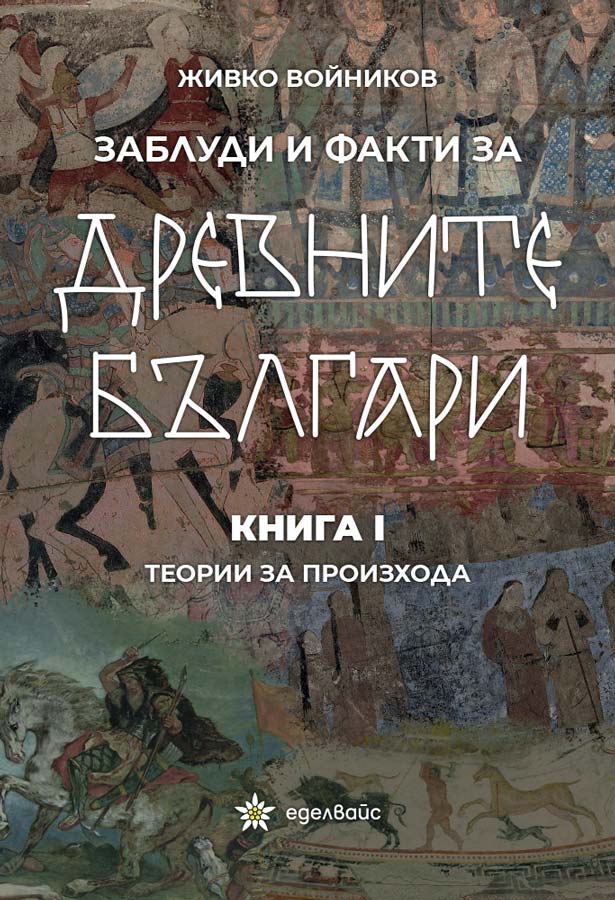
 Review of “Delusions and Facts about the Ancient Bulgarians. Book 1 – Origin Theories” (Pleven: Edelweiss Press Publishing House, 2022) by Zhivko Voynikov
Zhivko Voynikov’s book on origin theories is the first in a series of five books on the ancient Bulgarians. The author, a medical doctor by profession, is an independent researcher of the history and culture of the ancient Bulgarians and has published widely on the subject in recent years. The first volume published in Bulgarian in 2022 by Edelweiss Press Publishing House is arguably the most comprehensive overview and evaluation of the so-called theories on the origins of the ancient Bulgarians. It presents a well-informed detailed and critical analysis of origin theories based on hard and solitary work with an enormous body of literature – both academic and non-academic. It addresses a very complex, unprofitable and politically-charged problem in which science, emotions and politics intermingle. In a broader perspective, the work has also European implications as it sheds light on the history of the ancient Bulgarians as Indo-European nomads originating in Inner Asia and their role for the making of Europe.
As demonstrated in the book, many of the so-called “theories” about the origins of the ancient Bulgarians are in fact hypotheses, underdeveloped pre-theories, or highly speculative claims — ranging from pseudo-scientific assertions to biased interpretations by both academics and non-professional researchers. One of the main contributions of the work is that it highlights the impact of geopolitical interests and political factors on scholarship in the area of Bulgarian origins. This is most clearly demonstrated in the analysis of the strategic interests and competition between the Austro-Hungarian and the Russian empires on the Balkans in the 19-th and 20-the century. The geopolitical interests of the two empires had a significant influence on the theories concerning the origins of the ancient Bulgarians, particularly those developed within the Austro-Hungarian and Russian academic traditions of Turkic Studies, also known as Turkology (Voynikov, 2022: 50-88; 365). The role of Hungarian Turkology for the development of the Turkic myth about the Bulgarian origins is explained with much detail. Similarly, the negative influence of the Russian Pan-Slavic ideology and Turkology on the study of the ancient Bulgarians is specified. The positions of the Russian and Soviet scientific institutions on the issue of the Bulgarian origin are also closely related with Moscow’s politics of control over the non-Russian peoples in the Volga-Ural region.
Ideologically, the book is framed by a sort of “sobering traditionalism” — a blend of conservative values and sharp criticism of nationalist interpretations of Bulgaria’s past. Voynikov seeks to raise a sobering voice in the study of the ancient Bulgarians which is, to some extent, unorthodox. Origin theories — both in Bulgaria and elsewhere — are often emotionally charged and closely tied to nationalist sentiment, as nationalists tend to make up the core audience for such works. As a result, some in that audience may find Voynikov’s sober, non-nationalist approach unappealing. In this sense, his work is not market-oriented.
The book reflects the highly polarizing nature of its subject matter, the common origins of an ancient people with an undesirable present. The influence of online forum infighting is clearly felt throughout, detracting from the quality of the research. It is a highly polemical work, engaging in debate with different groups of opponents – both professional historians and non-professional researchers, many of whom are dismissed as “folk-historians”. More often than not, this engagement is hardly productive and detracts from the work’s otherwise very good scientific contributions.
Three specific examples illustrate this issue. First, it is not fair to equate the “folk-historians” in Bulgaria – who despite their flaws are driven by Bulgarian patriotism – with the Macedonists in Northern Macedonia. The latter, shaped by Serbian repression and despite being of Bulgarian ancestry, have developed openly hostile and racist attitudes toward Bulgarians. While the autochthonous or “Thracian” theory championed by Tzenov and his followers lacks scientific credibility, the critique of it could be phrased in a more measured and not so divisive way.
Second, the book would benefit from a more nuanced view of non-professional historians. For example, the first publications linking the ancient Bulgarians with the Tocharians appeared not in academic journals, but in Avi-tohol, a non-professional historical journal in the mid-1990s. In fact, Bulgaria currently lacks a high-impact, peer-reviewed historical journal and this absence leaves little space for alternative ideas to be properly scrutinized or developed within a formal scholarly discourse.
And finally, the author’s skepticism towards the present-day individuals and organizations in the Volga-Urals region claiming to be Volga Bulgarians is understandable as they have a completely different identity compared with the Bulgarian identity on the Balkans. However, the official politics of indifference regarding the Bulgarian legacy on the Volga is not a solution either. As a result from the politics of indifference not only the present-day Bulgarian movement on the Volga but also the Bulgarian historical and cultural legacy there has been increasingly appropriated by Pan-Turkic propaganda.
The main contribution of the book to scholarship on the ancient Bulgarians is the author’s Tocharian-Sarmatian hypothesis (Voynikov, 2022: 369-371) which is further developed in some of his other works. Drawing upon the chronicle of Michael the Syrian and Chinese sources, he argues that the earliest groups identified by the ethnonyms “Bulgars” and “Khazars” originally lived in the eastern part of the Tian Shan mountains in Central Asia. They were semi-settled nomads, part of the Tocharian tribes, i.e. Indo-Europeans but not Eastern Iranians. Very importantly, the author has also identified in this area the name “Unogundurs”, another name associated with the Bulgarian ethnonym which probably denoted the ruling clan or tribe. If the interpretation of the Chinese hieroglyphs is correct, this hypothesis could mark a breakthrough in the quest for the origins of the ancient Bulgarians — or at least, in tracing the emergence of the Bulgarian ethnonym in Central Asia.
Judging from Voynikov’s book and other works in this area three specific objectives of future research could be defined:
1. Unpacking and clearly defining the concept of origin. Surprisingly, this important conceptual problem has not been addressed in scholarship on the ancient Bulgarians.
2. International comparative analysis of origin theories of different European nations. This scientific objective could address the absence of an internationally recognized scientifically rigorous methodology for the study of ethnical origins.
3. Enhancing the cooperation culture among Bulgarian researchers and research institutions in the area of Bulgarian origin theories as well as international collaborations between Bulgarian and European researchers and research institutions in this area.
Bibliography:
Живко Войников, Заблуди и факти за древните българи. Книга I – Теории за произхода. Плевен: Издателство „Еделвайс Прес“, 2022.
Nikolay Pavlov