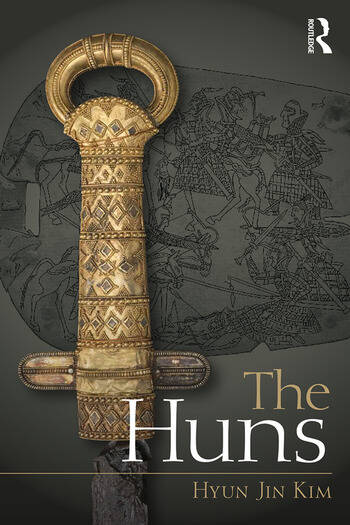
 Review of Hyun Jin Kim. The Huns. (London and New York: Routledge, 2016)
“The Huns” by Dr. Hyun Jin Kim stands out as a rare Hun-positive, even Hunophile work which is not common in research on the Huns dominated by the negative image in the classical Greco-Roman and Chinese historical sources. The author’s overall approach to the “mystery of the Huns” is scientifically credible. He argues that the Huns were highly heterogenous both ethnically / racially and linguistically. The Huns were in all probability “multi-ethnic and multi-lingual, consisting of a mix of a variety of Turkic and Iranian speaking peoples and ethnicities” (Kim, 2016: 15). The name Xiongnu – originally applied to the Huns in Chinese sources – was, Kim argues “a socio-political designation denoting a unified imperial political entity and it cannot be interpreted as the designation of a culturally or genetically homogenous group. It is a collective label of an imperial entity that encompassed a great variety of ethnic groups and archaeological cultures.” (Kim, 2016: 42). The author also presents new evidence supporting the identification of the Huns with the Xiongnu in political, cultural and religious terms — though not in terms of genetic or racial continuity.
In this train of thought, one could argue that “Hun” (Xiongnu) was used primarily as a geopolitical term in Late Antiquity and the Early Middle Ages to designate a geopolitical entity — the Hun empire and its successor states throughout Eurasia. As such, the name “Hun” shares structural similarities with modern terms like “Eurasian” or “Euro-Atlantic,” which are neither racial / ethnical nor linguistic labels. These are geopolitical designations with clear politico-military connotations — just as “Hun” (Xiongnu) carried a distinct politico-military meaning in its historical context. The Hun name designated a specific geopolitical identity. No other name so vividly captures the “zeitgeist” of Eurasia in this era, spanning roughly from the 3rd century BC to the 6th century AD.
The book’s main shortcoming is that the stated Eurasian, multi-ethnic methodological approach to the Huns has not been consistently employed. More specifically, the Indo-European component of the Hun imperium has been underestimated. While it is positive that the cultural impact of the Iranian-speaking Scythians on the Xiongnu is acknowledged in Chapter One, the later discussion reduces the role of the Scythian-Sarmatian tribes in the ethnogenesis of the European Huns and in Hunnic state-building in Europe largely to the contribution of the Alans. Bulgars are viewed from a pan-Turkic perspective which is not scientifically credible given the substantial body of evidence for their Indo-European origins, specifically Tocharian and Scythian ancestry (Voynikov, 2023).
It should be noted that this underestimation of the Indo-European component is characteristic of Hunnic studies in principle, which have long been dominated by Turkic studies in the academic world. And this is certainly neither the author’s fault nor his task (he is, after all, Professor in Classics at the University of Melbourne, Australia). The general indifference — or outright negativism — of European academic institutions to the Huns as a research subject has also contributed to the persistence of an exclusively pan-Turkic interpretation of Hunnic history. The only partial exceptions are Hungary (and, to a lesser extent, Austria), though in Hungary the strong pan-Turkic strand in Hungarian nationalism has hindered the development of an Indo-European scholarly perspective to Hunnic studies.
Interestingly, recent genetic studies provide no evidence for the presence of a large eastern/steppe descent community among the Hun- and post-Hun period (5-th to 6-th century AD) Carpathian basin population in Central Eastern Europe (Gnecchi-Ruscone, et.al. 2025). The results of this study show that the population of the Hun realm in Europe was genetically highly heterogeneous. There are also indications that some European Huns buried in 5th-century East Central Europe descended from the Central and Eastern Eurasian steppes: including but not exclusively, the former lands of the Xiongnu. While not explicitly stated due to political correctness, overall the genetic evidence implies that the European Huns were, in genetic terms, predominantly Caucasian.
Against this backdrop, the claim that “the Huns were largely an Oghuric Turkic speaking people” (Kim, 2016: 126) is not substantiated and detracts from the otherwise valuable research findings. Most of the proposed pan-Turkic etymologies for the words and names associated with the European Huns — including the so-called ‘Bulgar’ Huns — can be more convincingly explained through alternative Indo-European, particularly Iranian, etymologies (Бешевлиев, 1967; Добрев, 1994). The term “Oghuric Turkic” itself does not appear in any historical source; it is a socio-linguistic construct originating in the racially charged Turkic studies (Turkology) of the 19-th and 20-th centuries. There is no written evidence from any “Oghuric” language. All attempted reconstructions from the 19-th and 20-th centuries rely on the modern Chuvash language — most likely a direct descendant of the Sabirs, rather than of any “-gur” group. Notably, historical sources do not mention the Sabirs as belonging to Great Bulgaria under Khan Kubrat. Consequently, the use of Chuvash as a basis for reconstructing an imagined “Oghuric” language is scientifically questionable.
Very importantly, Procopius — the last major historian of the ancient world — explicitly identifies the Utigurs and Kutrigurs with the Cimmerians, an ancient Iranic nomadic people originating in the Pontic-Caspian steppe (Procopius, Book ІV.4 and ІV.5). Bulgars are attested living north of the Caucasus in the 2-nd century AD by the Armenian historian Movses Khorenatsi, well before the invasion of the Huns in Europe in the 370s (Голийски, 2006). This was the era of the mysterious Avitochol, listed in the Bulgarian Kings’ List as the first ruler of the Dulo dynasty, preceding Irnik. On the basis of linguistic and historical analysis, Tabakov (1995) argues that the name Avitochol is a composite of two elements: the ancient Iranian title Kavi (“king”) and Tochol, meaning “Tocharian” (rendered as Tu-huo-lo in some Chinese sources). The composite name would thus read as Kavi Tochol, or “King of the Tocharians.” Given the period of royal rule, Tabakov further suggests that the founder of the Dulo dynasty — Kavi Tochol — may in fact be identical with the Kushan ruler Kanishka.
Conclusion
The main contribution of the book lies in its emphasis on the great impact of the Huns on world history. The author speaks of a “Eurasia-wide geopolitical revolution in 4-5-th century AD” which is an objective assessment of the geopolitical impact of the Huns’ expansion. The Huns’ most indisputable achievement can be found in the area of military capabilities development, including advanced military technologies. The comparison between Chanyu Mo-du, the founder of the Xiongnu Empire, and Alexander the Great is both original and convincingly argued.
In certain respects, however, the book overstates the influence of the Huns. The claim that the political system of feudalism was introduced in Europe by the Huns could be contested with examples from the Roman political model which had strong influence on the “barbarian” states in Western Europe. Similarly, the bold statement that “the western fringe of Eurasia was forever after the Hunnic conquest politically separated from the Mediterranean basin” is simply untrue. For example, the medieval Bulgarian Empire maintained continuous political, economic, and cultural interaction with the Eastern Roman Empire (Byzantium) and, through it, with the Mediterranean world. Despite these shortcomings, The Huns by Dr. Hyun Jin Kim remains a valuable contribution to Hunnic studies. The book represents an ambitious attempt to attack a vast and complex research problem by a concise academic volume — an undertaking that is both commendable and deserving of respect.
Bibliography:
Gnecchi-Ruscone, Guido Alberto et. al. Ancient genomes reveal trans-Eurasian connections between the European Huns and the Xiongnu Empire, Proceedings of the National Academy of Sciences of the USA, 2025, Vol.122, No.9. https://doi.org/10.1073/pnas.2418485122
Kim, Hyun Jin. The Huns. London and New York: Routledge, 2016.
Procopius. History of the Wars (transl. by Henry Dewing). Ottawa: East India Publishing Company, 2023.
Voynikov, Zhivko. The ancient Bulgarians – who were they? A new look at the old question, Chronica. Annual of the Institute of History, University of Szeged, Vol.22, 2023.
Бешевлиев, Веселин. Иранските елементи у първобългарите, Труды Конференции по изучению проблем античности, Москва, 1967. 237-247. (Veselin Beshevliev. Iranian elements among Proto-Bulgarians, Proceedings from a Conference on the Problems of Antiqity, Moscow, 1967).
Голийски, Петър. Българите в Кавказ и Армения (ІІ-Х век). София: Тангра ТанНакРа ИК, 2006. (Petar Goliyski. Bulgarians in the Caucasus and Armenia (2-nd – 10-th century), Sofia, 2006)
Добрев, Петър. Светът на прабългарите. София: „Славика-РМ“, 1994. (Petar Dobrev. The world of the Proto-Bulgarians, Sofia, 1994).
Табаков, Димитър. К-ави (Кава-Кана) Туохол (Авитохол), сп.Ави-тохол №1, 1995. (Dimitar Tabakov. K-avi (Kava-Kana) Tuochol (Avitochol), Avi-tochol journal, no.1, 1995).
Nikolay Pavlov
Response to the review by Dr. Hyun Jin Kim