 The policy of forced mass immigration into Europe is becoming a grave violation of the human rights of indigenous Europeans. This is a form of anti-European racism which has devastating effects on international peace and security. In 2025 anti-European racism has already become a global security and human-rights problem which warrants a concrete geopolitical and territorial solution. Resistance against any form of racism is justified under international law. There is a peaceful and internationally legal way of resisting mass immigration by means of a concerted and well-organized migration of Europeans into a fitting host country in Europe which will serve as a European nationalist homeland, a sort of small-scale “Fortress Europe”. This will be an expression of the right to self-determination which is one of the core principles of international law. Paradoxically, those that seek to uphold European identity could do so by employing the migrants’ strategy, by weaponizing migration for their own strategic ends in a sort of European nationalist mobility.
Theoretical framework
The concept for a European nationalist homeland draws on international relations theory and geopolitical theory. The first assumption for the concept is that within European nations across the globe there are groups and individuals who have strong European and national identity, and are willing to preserve their identity, including by means of political struggle, resistance or even migration. The second assumption is that only a state can assure the security and survival of those Europeans who are willing to preserve their European and national identity. The second assumption is inferred from realist theory in international relations which is also known as the balance-of-power theory.
In “Politics among Nations” Morgenthau, one of the “founding fathers” of the realist school argues that international politics, like all politics, is a struggle for power (Morgenthau, 1949: 13-15). International politics is of necessity power politics. The struggle for power is universal in time and space and is an undeniable fact of experience. According to Morgenthau nation-states are the main players in the struggle for power on the international scene.
Classical realist theory as elaborated by Morgenthau can be of use for developing the concept for a European nationalist homeland by the insights on the state-centric model of international politics, the balance of power and its crucial role for maintaining international peace. The balance of power is viewed by Morgenthau as a self-regulatory mechanism on the international scene, as a natural and inevitable outgrowth of the struggle for power (Morgenthau, 1949: 125-137). The balance of power operates in the main by means of alliances and counter-alliances among a number of nations. The international system of the balance of power is not only inevitable, but an essential stabilizing factor. It has a restraining effect upon the nations actively engaged in the struggle for power. In a world whose moving force is the aspiration for power of sovereign nations, Morgenthau argues, peace can be maintained only by two devices: the balance of power and normative limitations such as international law. The balance of power is a device for the self-defense of nations whose independence and existence are threatened by a disproportionate increase in the power of other nations. So, one of the functions of the balance of power is to preserve the independence of weak nations.
From a classical realist perspective, Europeans wishing to keep their identity are exactly in the position of a weak nation which has the moral right to overthrow the existing international balance of power. Presently, there is no nation-state or international organization which fights anti-European racism, and this is a structural problem of the international system. A new balance of power in international relations is needed to guarantee the basic human right of Europeans to self-determination and identity. As a global and structural problem anti-European racism warrants a geopolitical solution at the global level which can effectively guarantee the protection of European human rights and enhance international peace and security.
Morgenthau’s balance-of-power theory – which is often referred to as classical realism – was further developed by Waltz who elaborated the so-called structural realism (or neorealism). In “Theory of International Politics” Waltz introduces the concept of structure to explain international politics (Waltz, 1979). A structure is an abstraction which is defined by the arrangement, or the ordering, of its parts. Unlike the domestic political system, the international system is decentralized and anarchic (Waltz, 1979: 88-9). International organizations either themselves acquire some of the attributes and capabilities of states, or they soon reveal their inability to act in important ways except with the support, or at least the acquiescence, of the principal states concerned with the matters at hand. The prominent characteristic of international politics seems to be the lack of order and of organization. States are the primary units of the international political system and they seek to ensure their survival. Waltz underscores that international politics is mostly about inequalities (Waltz, 1979: 94). So long as the major states are the major actors, the structure of international politics is defined in terms of them. States are differently placed by their power. Among states, the state of nature is a state of war (Waltz, 1979: 102). Among men as among states, anarchy, or the absence of government, is associated with the occurrence of violence. Self-help is necessarily the principle of action in an anarchic international order.
From a structural realist perspective, the current rise in anti-European racism represents a structural challenge for the current balance of power in international politics. Over the next 10 to 20 years – due to the advancement of the demographic decline of European nations and the increase in the immigration rate – anti-European racism will grow to become a structural problem of the international system, a problem of the ordering principle in international politics. The solution of the problem of anti-European racism lies not in domestic politics but in the anarchic domain of international politics. In the self-help system of international politics, the survival of at least part of the Europeans – those who wish to preserve their identity – will only be possible in a separate sovereign state. The survival motive is the major motive for setting up a homeland for European nationalists in a world where the survival and security of Europeans is no longer assured by traditional nation-states and international organizations. On the other hand, it will be a test for the ability of European nationalists to cooperate effectively, contributing to global peace and security.
Apart from realist theory, the concept for a European nationalist homeland is also theoretically informed by Mackinder’s Heartland theory which is widely considered to be the founding moment of geopolitics. Mackinder elaborates a correlation between the larger geographical and the larger historical generalizations, seeking a formula of geographical causation in universal history (Mackinder, 1904). Based on a historical and geographical analysis Mackinder argues that the vast continental area of Eurasia – which is covered mostly with steppes – is the pivot region of the world’s politics, holding the central strategical position in the World-Island. The “World-Island” is a term used by him to denote the joint continent of Europe, Asia and Africa. In his seminal work “Democratic Ideals and Reality” Mackinder gives a wider extension of the “Heartland” as a strategic concept to include not only the pivot area but also Eastern and Central Europe with the basins of the Black and Baltic Seas (Mackinder, 1942: 76). In his words: “regarded from the point of view of human mobility, and of the different modes of mobility, it is evident that since land-power can today close the Black Sea, the whole basin of that sea must be regarded as of the Heartland” (Mackinder, 1942: 77). Historically, the Heartland is associated with land-power and the constant “hammer blow” of horsemen riding from the Heartland into the European peninsula.
Mackinder (1942: 106) summarized his theory thus:
“Who rules East Europe commands the Heartland:
Who rules the Heartland commands the World-Island:
Who rules the World-Island commands the World.”
Despite its shortcomings Mackinder’s Heartland theory is one of the best geopolitical explanations of world history and politics. It clearly explains the geopolitical rationale of the clash between Nazi Germany and the Soviet Union over Eastern Europe and the Heartland. Later on, some of the basic geopolitical ideas have been employed by U.S. strategists, most notably by Kennan and Brzezinski in the U.S. politics of containment – first against the Soviet Union and afterwards against the Russian federation. The fight for control over the Heartland in the first decades of the 21-st century, including NATO’s Eastern expansion and the war in Ukraine could be best explained in geopolitical terms and, especially in terms of the Heartland theory. With its focus on the geopolitical significance of the pivot position Mackinder’s Heartland theory is also very helpful for the development of the concept for a European nationalist homeland and, specifically for positioning it geographically.
The concept of Identaria is based on the assessment that, despite numerous points of conflict (such as the war in Ukraine) the current international balance of power remains mutually beneficial for the two major geopolitical actors – the Eurasian Heartland (the alliance between Russia and China) and the U.S. dominated Euro-Atlantic “imperium”. The government of the Russian federation and the U.S federal government are equally interested in maintaining the current balance of power in the Eurasian and the Euro-Atlantic geopolitical areas. Therefore, despite the regime change in Washington and the second presidency of Donald Trump starting from January 2025 it is not realistic to expect a major change in the international system of balance of power. Indeed, Trump’s tougher policy on immigration might have some temporary effect in the U.S. but overall, the current trends of mass migration into Europe are likely to remain steady, if not increase further. It is very unlikely that the European Commission in Brussels will allow the introduction of Trump-like remigration policies in EU member states. The only likely exception is Hungary, which has carved out a niche for maneuvering in this regard.
At this geopolitical backdrop, a new viable concept for effectively solving the global problem of anti-European racism and the related forced mass immigration to Europe could be defined. This alternative is the concept for developing a European nationalist homeland, a single state for European nationalists and identity keepers in Europe (Pavlov, 2024). Being identity-based, the European nationalist homeland could tentatively be named “Identaria”.
Identaria can be defined as a European multiethnic nationalist state with ideologically homogenous population, consisting of European nationalists and identity keepers coming from different nationalities. Of course, all Europeans willing to keep their identity should be welcome to the Identaria project. In practice, it is very likely that most of the identity keepers will actually be nationalists and patriots of their respective countries. European nationalists (including members of Identitarian organizations) are already forming an invisible and dispersed community which could be transformed into a European nationalist state with its own territory. So far, European nationalists have been homeless and stateless which warrants the creation of a real-world and territory-based community. With the development of Identaria a homeland of European nationalism will be created to serve both as a gathering point and a safe haven for European nationalists.
The host
Identaria should be positioned in an already existing state which will serve as a host country for developing the European nationalist homeland. Given the geopolitical significance of the Heartland, the best option for a host will be a country located in the Heartland. Most of the Heartland is taken by the Russian federation which is too powerful and anti-nationalist to allow the development of a European nationalist state on its territory. Therefore, a more realistic option is to set up Identaria in a weak state in the non-Russian part of the Heartland, that is in Eastern or Central Europe. The geopolitical significance of Eastern and Central Europe for control over the Heartland – as clearly explained by Mackinder – should be considered as an important factor for positioning the European nationalist homeland there. European nationalism must move to the Heartland and go continental in order to succeed. In a way this will be a return back home to the Black Sea area – in relative proximity to the Caucasus Mountains – a region which is considered by many scholars to be the European ancestral homeland. Even if the scientific evidence for the original European ancestral homeland cannot be regarded as conclusive, the term “Caucasian” is an established term for referring to persons of European descent. Therefore, Identaria’s relative proximity to the Caucasus will bear a symbolic significance.
Eastern Europe is widely considered to be more “tough”, “hardcore” and more immune to Western decadence and left-wing totalitarian wokeism. Apart from geopolitics and culture there are also a number of practical arguments in support of the idea to position the European nationalist homeland in Eastern or Central Europe. Land and housing prices in all Eastern European countries are lower compared with Western Europe and the U.S. Women in Eastern Europe are very well-disposed to white men coming from Western Europe and the U.S., irrespective of their nationalist views. Weaker state institutions and a weaker repressive regime would enable the development of parallel European nationalist institutions. Last but not least, the host country should be a member of the European Union as this will facilitate the free movement and mobility of European nationalists from Western Europe and potentially from the U.S. At the same time, U.S. dominance over the host country should not be too strong as this will impede the implementation of the Identaria project. Therefore, the Baltic countries – which are under very strong U.S. dominance – do not seem appropriate as host countries. Taking into account all abovementioned criteria, the most appropriate geographical location of Identaria’s host country is the Black Sea area of the Heartland or the Middle Basin of the Danube – where the Great Steppe of Eurasia actually ends.
Nationalist mobility
Identaria must be designed to provide geopolitical space for pooling European nationalist resources in terms of manpower and capabilities. Therefore, international cooperation between European nationalist organizations and individuals is of crucial importance. Identaria must be formed as a state-alliance of European nationalists for countering anti-European racism and non-European migration. For the effective organization of the nationalist mobility a consortium of nationalist groups and stakeholders should be built up. The consortium will be the main Identaria project management body. Identaria will be formed by regular and constant nationalist mobility (migration) from European countries (and possibly the U.S.) to the chosen host country. Large changes are ordinarily brought about by the accumulation of small decisions. Nationalist expats coming from European countries will be the pioneers of Identaria. The relations with the local European population of the host country should be amiable and non-confrontational. Once the quantity of European nationalists in the host country prevails, peaceful political actions should be taken for bringing about European nationalist regime change. Thus, in a most democratic way, a European nationalist majority will make it possible a peaceful regime change – not only at the metapolitical but, more importantly, at the political level. Finally, coming from the fringes of politics in their states of origin European nationalists will hold the whip hand in Identaria. As a new and independent state Identaria should pursue a policy of neutrality and non-alignment in political and military alliances.
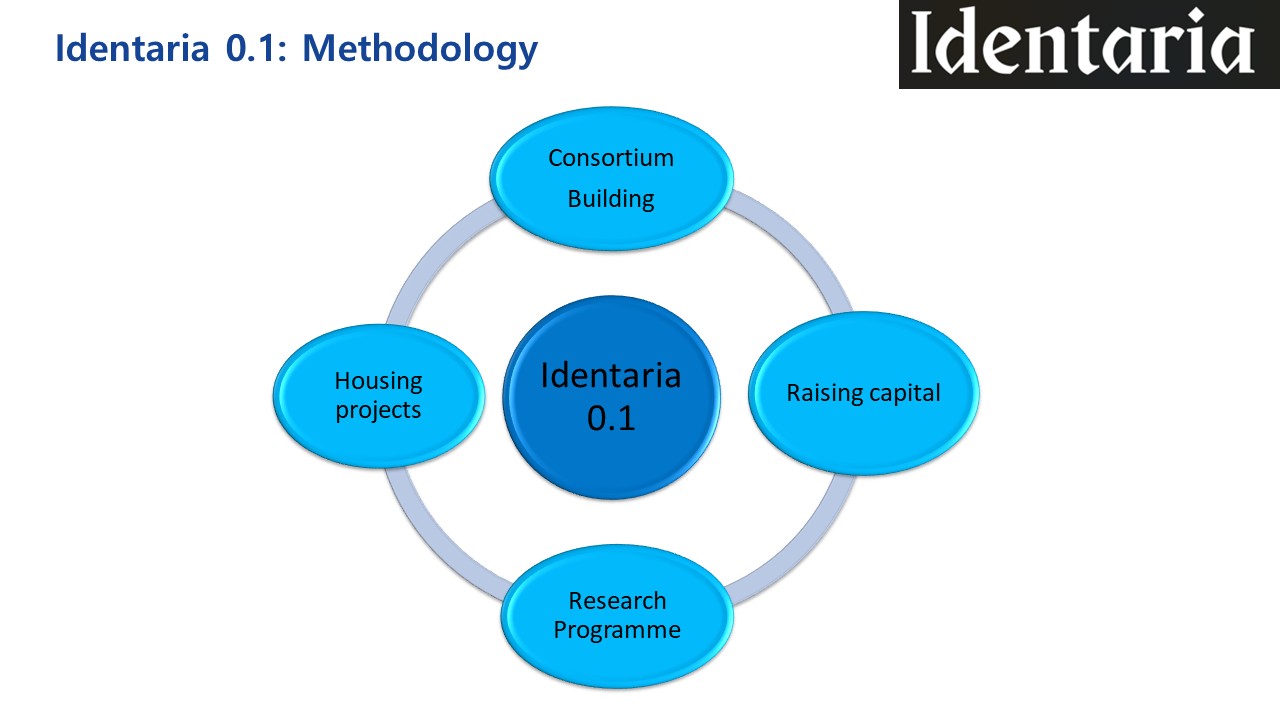
In the first phase, the Identaria project will follow a four-step operational logic, as shown on Fig.1:
– Building the consortium;
– Raising capital (by means of fund-raising initiatives or an investment fund);
– Developing a Research programme;
– Implementing housing projects.
Identaria is designed as an innovative and original concept development and experimentation project. Of course, some parallels between the concept of Identaria and other political and metapolitical concepts such as Zionism and Puritanism could be drawn. Similar to Zionism, the Identaria project is a state-building nationalist concept which seeks to put an end to a specific form of racism by establishing a homeland – in the classical form of a territorial state – for a specific group of people. Puritans, and especially the Separatist and Independent strands in Puritanism, advocated separation from all other established Christian denominations in favour of autonomous gathered churches. The Puritans played a significant role not only in reforming the Church of England, but also in English history (under Cromwell) and in early American history (especially, in New England).
A parallel could also be made between the concept of Identaria and the small town of Orania in South Africa. Orania was founded in 1991 with the goal of creating a stronghold for the Afrikaner minority group, the ethnic group descended from the Europeans who colonized South Africa. Of some relevance is also the “Moving together” initiative (“Initiative Zusammenrücken”) in Germany. The initiative aimed to support the moving of Germans from Western Germany – from areas that have been overrun by immigrants – into Central Germany, more specifically to the provinces of Saxony and Thuringia. The lessons learned from small-scale initiatives such as Orania and Initiative Zusammenrücken must be taken into account in the planning process of the Identaria project. More specifically, the crackdown on Initiative Zusammenrücken in 2023 clearly demonstrates that it is pointless to waste effort and resources for European nationalist projects in a state with strong totalitarian traditions as Germany. Moreover, it is exactly in Germany that Europeans willing to keep their identity are especially vulnerable to persecution, discrimination and harassment. During protests against Alternative for Germany in January 2024 there have been calls for banning the party and even for deprivation of citizenship (Ausbürgerung) of its supporters (Krone, 20 Jan 2024). If implemented, the totalitarian practice of political and ethnic cleansing and deportation in Germany may lead to a humanitarian crisis with potentially millions of German nationalist refugees forced to flee the country. This scenario should be taken into account in the context of enhancing the peace-building potential of European nationalism.
Identaria should be designed as a revisionist state, that is a state that seeks to alter the balance of power. The establishment of Identaria will be a structural change in the international system in terms of mitigating and putting an end to anti-European racism. The development of a European nationalist homeland will prevent a potential migration-fuelled civil war in Europe as it will provide a territorial safe haven for European identity keepers and nationalists. By implementing the Identaria project European nationalism will start to play an active role in the modern international order. No lasting and credible international order in the 21st century would be possible without the involvement of European nationalism and without the abolishment of anti-European racism and discrimination at the global level.
Identaria is far from being a quixotic project. The concept for a European nationalist homeland is a pragmatic policy-oriented solution to the problem of anti-European racism – a solution, which takes into account the structural constraints of international politics. It draws upon realist and geopolitical theories and takes into account the actual potential of European nationalist movements. What is attainable in balance-of-power international politics seems to be one small multiethnic European nationalist state for the European nationalist and Identitarian tribe, based in Eastern or Central Europe where no one will take it seriously at first. The establishment of Identaria inevitably will reinforce the nation-building process which has been initiated by the Identitarian organizations across Europe in the first two decades of the 21st century. Identitarian will gradually transform into Identarian. The sovereign of Identaria will have the power and the right to decide on the exception, including on immigration. Along with the solid ground of a territorial state the Identaria nation-building project will provide an unparalleled ideological and cultural cohesion to serve as a basis for a more assertive geopolitical posture in the future. A strong independent and neutral Identaria, well-positioned in the western end of the Heartland could become not only the “holder” of European nationalism but also the “holder” of the balance of power between the Euro-Atlantic and the Eurasian monsters. Thus, a good concept for the promised homeland of European nationalism can tip the future!
And, to conclude in the language that has inspired legions of European nationalists in the past:
Identaria, erwache!
Bibliography:
Mackinder, Halford J. The Geographical Pivot of History, The Geographical Journal No.4, Vol XXIII, April 1904.
Mackinder, Halford J. Democratic Ideals and Reality: A Study in the Politics of Reconstruction. London: Constable Publishers, 1942 (first published in 1919).
Morgenthau, Hans. Politics among Nations. The Struggle for Power and Peace. New York: Alfred A. Knopf, Inc., 1949.
Pavlov, Nikolay. Developing a European Nationalist Homeland. Identaria, 2024.
Sekulović, Andrej. Remigration Now: Echoes from the Streets of Vienna. Arktos Journal, Aug 02, 2025.
Schmitt, Carl. Political Theology. Four Chapters on the Concept of Sovereignty. (translated by George Schwab), Chicago: The University of Chicago Press, 1985 (first edition – Berlin, 1922).
Sellner, Martin. Remigration. Ein Vorshlag. Schnellroda: Verlag Antaios, 2024.
Waltz, Kenneth N. Theory of International Politics. Reading, Massachusetts: Addison-Wesley Publishing Company, Inc. 1979.