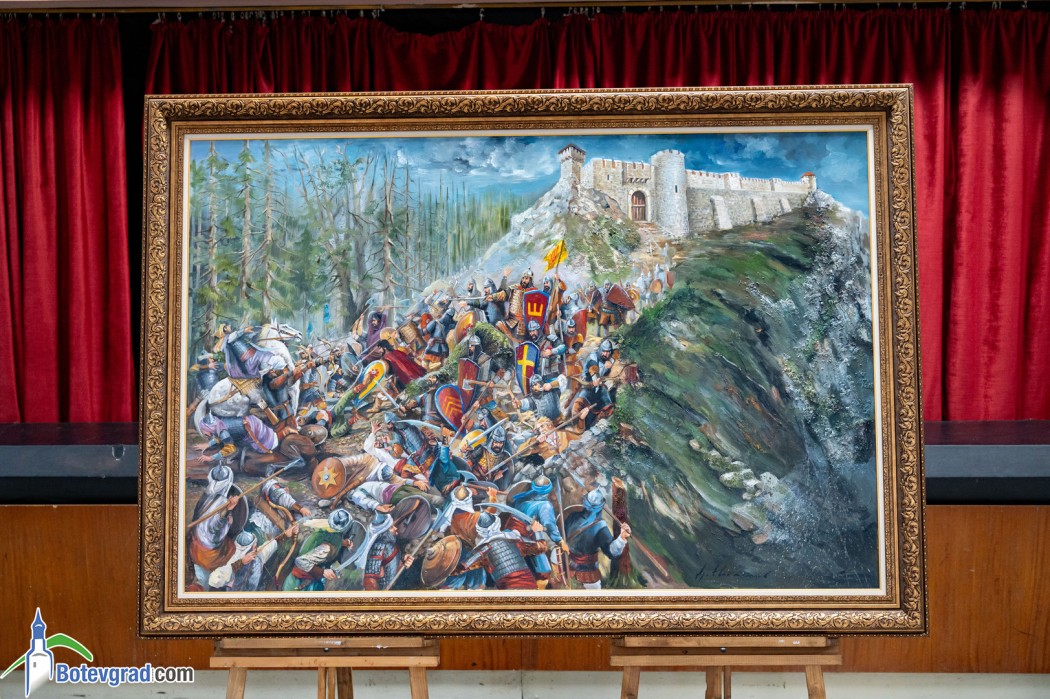
The Janissaries formed the primary land forces of the Ottoman-Turkish army and they were recruited forcibly from the Christian peoples in South-Eastern Europe by the system of child levy enslavement called “blood tax”. Christian boys were forcibly taken from their families at around the age of ten, converted to Islam, indoctrinated, and ultimately turned into fervent supporters of the Ottoman-Turkish regime. The Janissary phenomenon is one of the examples of the genocidal policies of the Ottoman-Turkish state against the Christian European peoples on the Balkans (1). The Janissary Corps practically held the monopoly on the use of force in the Ottoman-Turkish empire and became a major political player which was able to overthrow the Ottoman-Turkish sultan (2). Until 1826 when the Janissary Corps was disbanded the Janissaries have been responsible for the major repressions and acts of genocide against the subjugated Christian European peoples on the Balkans.
The Movement for Rights and Freedoms (MRF), a political party established in Bulgaria in 1990 had its roots in Turkish terrorist organizations which committed terrorist acts in the 1980s including acts targeted against children (3). Tellingly, in 1993 the MRF erected in the village of Tarnak a memorial plaque to the convicted terrorists. Since its establishment the MRF has been covertly and openly supported by Turkey and has actively promoted Turkish nationalism, including among Bulgarian Muslims of non-Turkish descent (the so-called Pomaks). The methods for enforced Turkicization and assimilation of Bulgarian Muslims employed by the MRF have been sharply exposed by Sahatchiev (4). Hence, the MRF is widely perceived as a “Turkish party” by Bulgarian society. Since its establishment the party has not denounced the genocidal Ottoman-Turkish yoke over the Bulgarian people, nor the genocidal politics of child levy enslavement in the Janissary Corps. Despite a constitutional court file to ban the party as anti-constitutional on the ground of its ethnical character it was treated favorably by the Constitutional Court which ruled against banning the party.
On several occasions the party’s long-standing leader Ahmed Dogan weaponized the ethnical card with hardly veiled threats against the ethnical peace in Bulgaria, including threats of a “Kosovo scenario”. At a political rally in the village of Kornitsa held in March 2003 the high-ranking MRF activist Redjep Molla Ahmed called for the expulsion of Christians from the Rhodope Mountains and for imposing Turkish as an official language in the educational institutions in “our regions”. The politics of ethnic division pursued by the MRF is most visible in the regions with “mixed population” governed by the MRF. In these regions, there have been numerous complaints from Bulgarians over discrimination on the grounds of ethnicity by MRF-controlled public institutions. The model of ethnic discrimination was also transferred at the national level. The deputy-minister of agriculture Nihat Kabil of the MRF had reportedly called the public officials at the ministry with the discriminatory and hateful Ottoman-Turkish slur “Giaour” meaning “infidel”, “non-Muslim” (5). The violations of human rights by the MRF prompted in 2003 the setting-up of Bulgarian Human Rights Association, a specialized charity for the protection of human rights of ethnic Bulgarians in Bulgaria.
A mafia-like MRF network of influence has been spun in key public institutions such as the Judiciary, the Prosecutor’s office, the Ministry of Home Affairs and State Agency “National Security”. The “Janissary model” of ethnic Bulgarians serving the MRF rather than public interests has been enforced in the public administration. A sinister example of the mafia-like nature of the party was the demonstrative suicide of high-ranking MRF official Ahmed Emin, chief of the political cabinet of the party’s leader. Emin shot himself in the party’s luxurious premises in 2008 leaving a suicide note addressed to the party’s leader which allegedly hinted at the party’s “dirty secrets”.
With the generation of political capital and power by the MRF more ethnic Bulgarians were recruited in the party. This process was completed after a successful coup in 2024 when the party’s “honorary chairman” Ahmed Dogan was effectively removed from the position and the party’s leadership was taken over by Delyan Peevski who is formally of Bulgarian descent. With the change in leadership the party was re-branded as “Movement for Rights and Freedoms – New beginning”. The new MRF leader, Peevski is a person with a remarkable track record of scandals and is one of the very few Bulgarian politicians sanctioned by the U.S. and the UK under the Global Magnitsky Act for significant corruption. The U.S. Department of the Treasury described Peevski as “an oligarch who previously served as a Bulgarian MP and media mogul and has regularly engaged in corruption, using influence peddling and bribes to protect himself from public scrutiny and exert control over key institutions and sectors in Bulgarian society” (6). The sanctions under the Magnitsky Act, however, did not oust Peevsky from power. The main consequence thereof was an increase in the “Euro-Atlantic” self-identification of the MRF leader and, respectively in the MRF support for the Ukraine in the war against Russia.
The recruitment of more ethnic Bulgarians in the MRF has led to some changes in public perceptions and terminology. The MRF has been increasingly defined by public opinion, politicians and journalists in terms of the Janissaries in the Ottoman empire. For example, Karbovsky employs the terms “the new Janissaries” (7). Doncheva refers to the MRF as “a formally Turkish ethnic party which is served by Bulgarians-Janissaries” (8). Discussing the processes in the MRF in 2024 Kostadinov argues that there is “a clash between Janissaries and Turks in the ethno-oligarchical mafia MRF in which the Janissaries are trying to take hold of the MRF from the Turks” (9).
It would be unfair to classify all members and sympathizers of the MRF as “Janissaries”. The term can be applied in a justified way only to those MRF leaders and activists who share the following characteristics with the authentic Janissaries:
– hatred against the Bulgarian people;
– willingness and activities to oppress all those who are opposed to MRF policies and human rights violations;
– subservience to and dependence on institutions, organizations and power centres in the Republic of Turkey.
Therefore, the term “Janissary party” in this article refers not to the MRF party as a whole, neither to all of its members. It is legitimate to employ the term only regarding those MRF leaders and activists who share with the authentic Janissaries the following characteristics: hatred against the Bulgarian people; willingness to oppress its opponents and subservience to the Republic of Turkey.
The Attack on the town of Botevgrad
One of the recent examples of the MRF anti-Bulgarian policies is the attack on the small and heroic town of Botevgrad located in the Western parts of the Balkan Mountains. The region, with the fortress of Bozhenishki Urvich as its political and cultural center, was one of the last strongholds of the medieval Bulgarian Kingdom in its unequal fight against the Ottoman-Turkish invasion. As evidenced in a stone inscription from the 1380s the regional governor, sevast Ognyan “held the faith” of the Bulgarian King Ivan Shishman in the fight against the Turks. The region also played an important role in the armed struggle against the Ottoman-Turkish yoke in the second half of the 19th century. One of the most active secret revolutionary committees of the great Bulgarian revolutionary and freedom-fighter Vassil Levski was based in Orhanie (modern-day Botevgrad). In 1873 after an organizational failure several members of the local revolutionary committee were imprisoned under horrible conditions in the Ottoman Turkish prisons in Asia Minor. Many revolutionaries from the region joined the Bulgarian voluntary forces (Opalchenie) and took part in the Russo-Turkish War of 1877-1878.
At this historical background, “MRF-New beginning” chose the town of Botevgrad as one of the venues of its partisan pro-government rallies in December 2025. The planned demonstration was intended as a provocation against the local population of Botevgrad as there is neither Turkish nor Muslim population in the town. The electoral base of the party in this Bulgarian town is minimal. Hence, the planned rally was perceived by most citizens as a threat against local peace and security, as an attack on the town and its citizens inspired by traditional MRF ethnic division policies. There were strong voices in favour of organizing a counter-protest in defence of the town and against the MRF rally. In response to growing public concerns the mayor of Botevgrad Ivan Gavalyugov issued on 09.12.2025 an order forbidding the MRF rally (10). Very likely this is only a first step in a long battle and lawfare of Botevgrad municipality with the MRF as the party has strong positions in the Judiciary and other public institutions by means of politically dependent judges and civil servants. An appeal has been lodged by the MRF against the mayor’s order and new ethnically-charged provocations against the town of Botevgrad could be expected.
It is still unclear whether the planned rally in Botevgrad is part of a wider MRF scenario for incitement of ethnic hatred and sparking an ethnic conflict in Bulgaria. Now the question is: how far will the MRF go? Will it spark an ethnic conflict in Bulgaria in order to preserve its hold on power? Given the traditional MRF ethnic division policies and the strong support from Turkey this is a very dangerous scenario for the future of Bulgaria and Europe as a whole. Botevgrad’s firm resistance to all forms of anti-Bulgarian hatred and to the incitement of ethnic conflict should be appreciated throughout Europe. By preventing the MRF rally and by its readiness for a counter-protest Botevgrad becomes aligned with the great European towns of Vienna, Paris and London where protests upholding European identity and against Islamization have been held increasingly over the last years. Resistance and fight against anti-Bulgarian and anti-European policies in Botevgrad are a contribution to the freedom, security and defence of Bulgaria and Europe as a whole.
References
1. Йотов, Борислав. Международно наказателно право. София, Издателство Фенея, 1999.
2. Георгиева, Цветана. Еничарите в българските земи. София: Издателство „Наука и изкуство”, 1988.
3. Гочева, Паунка. ДПС в сянка и на светлина. София: Импрес, 1991.
4. Сахатчиев, Живко. Якоруда – българската драма. София: Издателство Тангра ТанНакРа, 2007.
5. See, for example: Capital weekly, Sep 17, 2005.
6. U.S. Department of the Treasury Press release, June 2, 2021.
7. Карбовски, Мартин. Новите еничари, Lentata, 07.02.2015
8. Дончева, Татяна. ДПС – етническа партия, обслужвана от “еничари” (интервю в БТВ, 26.08.2014).
9. Костадинов, Костадин. Само „Възраждане“ може да направи стабилно правителство, 29.06.2024
10. Заповед №ОА-894/09.12.2025 на Кмета на гр.Ботевград